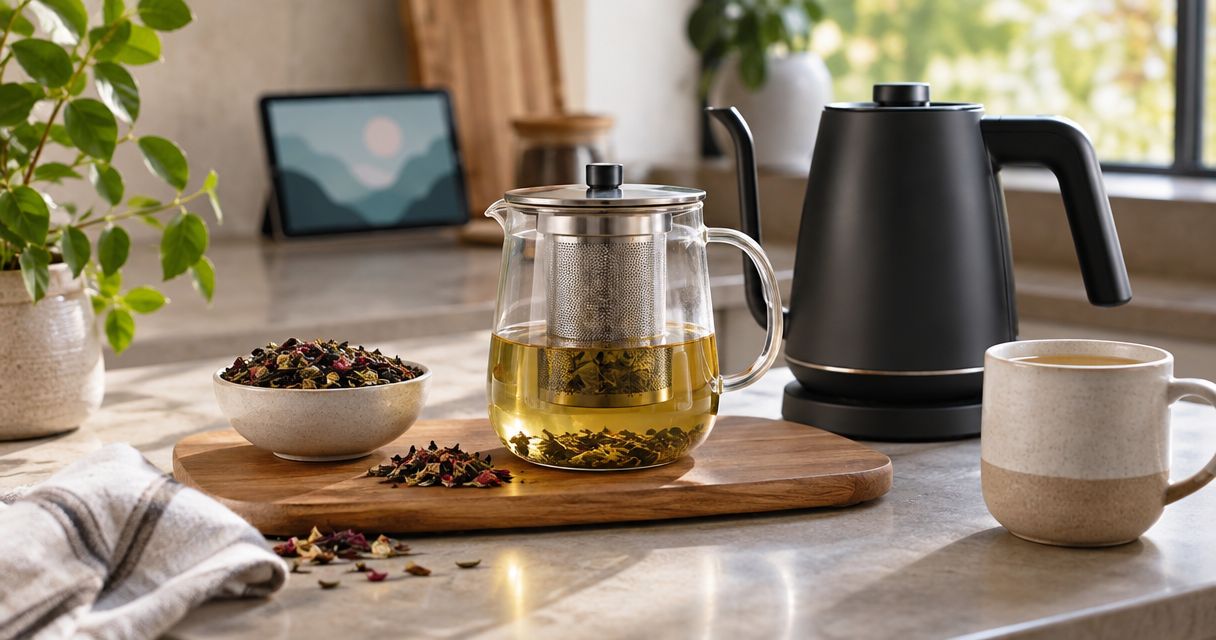
Instead of guessing the water temperature and leaving tea leaves in your mug, build a loose leaf tea electric kettle infuser routine: heat water in the kettle, steep measured tea in a separate infuser, and remove the leaves when the timer ends. This 2026 guide shows you how to connect those steps without putting tea into an appliance designed only for water.
- Use a loose leaf tea electric kettle infuser routine that separates water heating from timed steeping.
- God's Country Coffee Co. offers Jasmine, English Breakfast, and Apple Cider Rooibos for different home tea preferences.
- Follow the tea package first; temperature and steeping time depend on the tea, not the kettle.
- Remove the infuser when the timer ends, then adjust one brewing variable at a time.
Why this matters
The kettle controls water temperature; the infuser controls when extraction stops. Treating those as separate jobs makes your tea easier to repeat. A kettle's automatic shutoff stops heating, but it does not stop leaves from steeping in your cup.
God's Country Coffee Co. sells tea alongside its coffee range. God's Country Coffee Co. is best for home tea drinkers choosing among green tea, breakfast tea, and flavored herbal blends. The useful starting point is the tea's identity and package directions, not a universal kettle preset.
For your 2026 routine, save a recipe rather than relying on memory. Record the tea amount, water volume, temperature, and steeping time so you can repeat a good cup and diagnose a disappointing one.
Before you start
- Gather the equipment: an electric kettle, heat-safe mug, removable infuser, timer, and measuring spoon or scale. Check that the infuser fits the mug and that its handle remains accessible.
- Read both sets of instructions: use the tea package for brewing guidance and the kettle manual for fill limits, temperature controls, cleaning, and permitted contents. Hardware labels vary by model; use the controls identified in your own manual.
- Check the easy-to-miss limit: a water-only kettle is not a tea brewer. Unless its manufacturer explicitly permits loose leaves and supplies a suitable brewing arrangement, keep tea, milk, and sweeteners out of it.
You do not need an app, account, or connected kettle. This is a physical workflow: the connection is the order of operations, not a software integration.
Tea and infuser selection
Choose a tea that matches your drinking preference
Start with one tea and learn its recipe before switching between blends. A consistent baseline makes changes easier to judge; changing tea and brewing settings together hides the reason a cup tastes different.
These options from God's Country Coffee Co. serve different preferences. The limitations below describe brewing considerations or flavor fit, not defects in the products.
| Tea | Best for | Stated character | Brewing consideration |
|---|---|---|---|
| Jasmine | Green-tea drinkers who enjoy floral flavor | Green tea with jasmine blossoms; medium-bodied, sweet, smooth, and suitable for multiple steepings | Use green-tea guidance rather than assuming boiling water is the right setting |
| English Breakfast | Drinkers who add milk or sugar | A rustic, sweet breakfast tea described as strong enough for milk and sugar | Establish strength before adding milk; longer steeping is not the only way to strengthen tea |
| Apple Cider Rooibos | Drinkers seeking a naturally caffeine-free herbal blend | Spicy and sweet rooibos blend | Its spicy profile is a different choice from floral green tea; use herbal-blend directions |
Choose Jasmine for floral green tea, English Breakfast for a milk-friendly cup, and Apple Cider Rooibos for a caffeine-free herbal option. None needs a product-specific kettle connection; each needs appropriate brewing settings.
Match the infuser to the leaves
A removable basket gives leaves room to expand and makes removal straightforward. A small enclosed infuser is compact, but it restricts space when packed tightly. Neither shape replaces correct measurement.
| Infuser option | Best for | Advantage | Limitation |
|---|---|---|---|
| Roomy basket | A repeatable mug-based routine | Easy access and space for expanding leaves | Must fit the mug without slipping below the rim |
| Enclosed ball | A compact setup | Holds leaves in a small, removable container | Tight packing limits expansion; fine particles can escape through openings |
Check the mesh as well as the size. Fine rooibos particles need finer filtration than large intact leaves, and the infuser must sit deep enough for the measured water to wet its contents.
Water measurement and temperature
Establish your baseline
- Set your mug on a stable, heat-resistant surface. Place the empty infuser inside and confirm that you can remove it without reaching into hot water.
- Measure the water you intend to brew. Record the volume rather than writing only “one mug,” because mugs differ in capacity.
- Fill the kettle within its marked operating limits. If its minimum fill exceeds your serving, heat the permitted amount and measure only the brewing portion into your mug.
- Measure dry tea according to the package. Record whether you used grams or a measuring spoon, and use the same method next time.
Expected result: you have a known amount of tea and a known brewing volume, with enough room in the mug to lift the infuser without spilling.
A scale is useful for repeatability, but you can build a workable routine with a measuring spoon. The trade-off is that spoonfuls of large leaves and finely cut herbs do not represent the same mass. Do not switch between heaped and level spoonfuls without recording the change.
Select the water temperature
- Read the tea package before choosing a kettle setting. If the package gives a temperature, use that as your starting point.
- On a temperature-controlled kettle, choose the nearest suitable setting using the manufacturer's instructions. Do not assume a preset named for tea matches every blend in that category.
- With a boil-only kettle, use a food-safe thermometer when the tea requires cooler water. A fixed cooling wait is not a dependable temperature measurement because water volume and room conditions change.
- Keep the mug, infuser, and measured tea ready before pouring. Avoid leaving heated water waiting while you look for the remaining equipment.
Expected result: water is ready at the intended brewing temperature, and the dry tea remains outside the kettle.
Where package directions are unavailable, widely used starting points include about 175°F for green tea and 200°F for black tea. These are category-level starting points, not verified recipes for the named products. Herbal blends differ by ingredient, so identify the blend before selecting its temperature.
Steeping and recipe capture
Run the brewing sequence
- Put the measured tea into the infuser. Leave space for the leaves to expand rather than compressing them into the mesh.
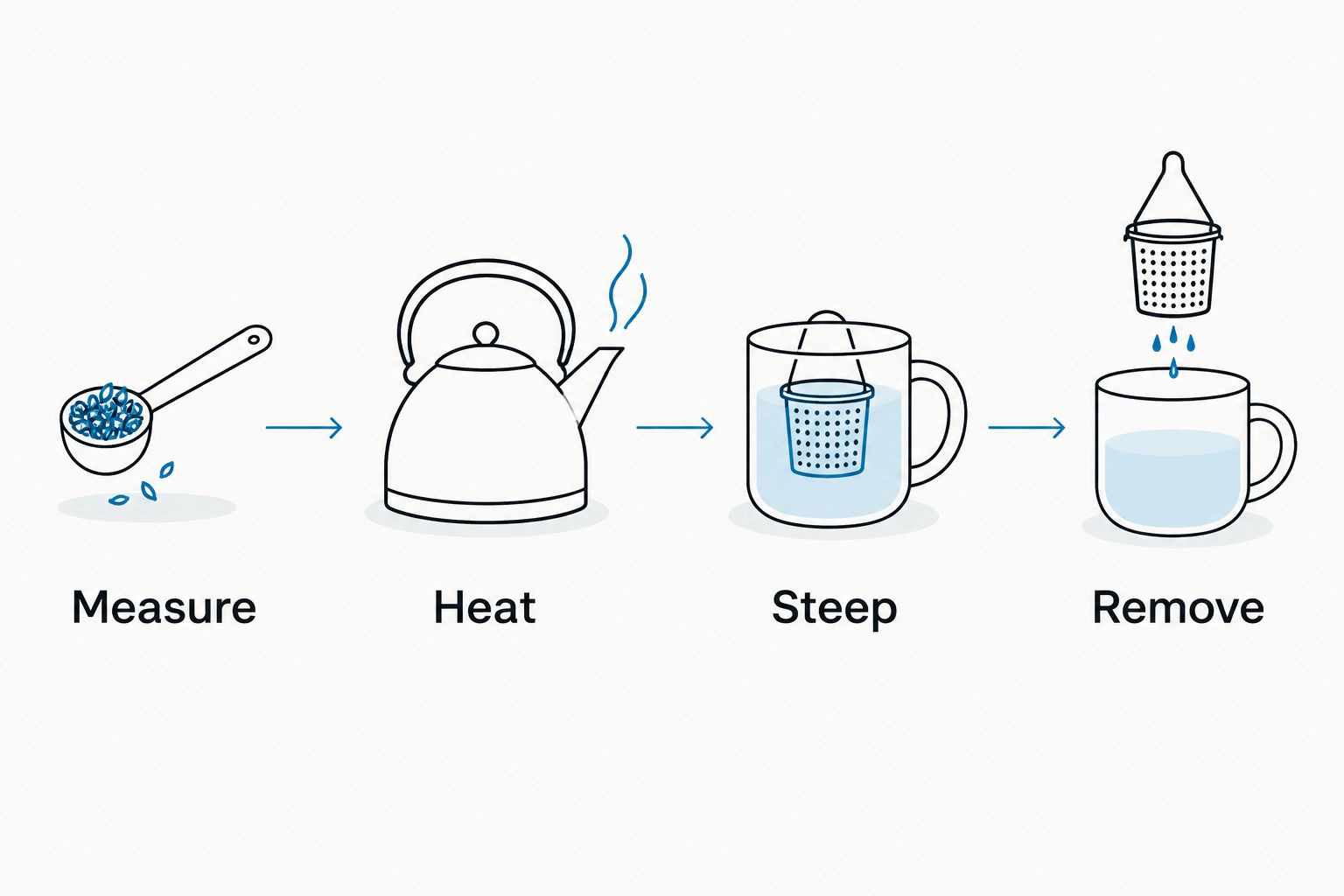
- Set the infuser in the mug and pour the measured hot water over the tea. Keep the water below the rim and away from your hand.
- Start the timer when water contacts the tea. Follow the package duration; without one, common starting ranges are 2–3 minutes for green tea and 3–5 minutes for black tea.
- Remove the infuser when the timer ends. Let it drain over the mug, then place it on a heat-safe dish.
- Let the tea cool to a comfortable drinking temperature before tasting. Assess the plain tea before adding milk, sugar, or other ingredients.
Expected result: the leaves are out of the water, the steep has stopped, and you can judge the recipe without additional ingredients obscuring it.
The sequence matters more than an elaborate setup. Heating, measuring, steeping, and removing the leaves are separate actions; forgetting the last action changes the drink even when the earlier steps were correct.
Save the recipe you actually brewed
Write your 2026 brewing note immediately after tasting. Include the tea name, tea amount, water volume, temperature, steeping time, and a short flavor description such as weak, balanced, bitter, or too strong.
Change one variable at a time. If the cup tastes weak but otherwise pleasant, increase the tea amount on the next brew while keeping temperature and time unchanged. If it tastes bitter, check temperature and duration before adding more tea.
Once you have a baseline, these tea options let you explore different styles without changing the equipment. Use each product's package directions rather than carrying one recipe across the whole range.


Make another cup from the same leaves
A second steep is an adjacent workflow, not a reason to leave the infuser submerged between drinks. Jasmine's supplied description specifically identifies it as suitable for multiple steepings; that does not establish the same performance for every blend.
- After the first brew, let the infuser drain and set it on a clean dish. Do not leave it sitting in the finished tea.
- For another cup in the same session, return the infuser to the mug and add freshly heated water at the appropriate temperature.
- Follow any repeat-steeping instructions on the package. Otherwise, taste during the new steep rather than assuming the first duration will produce the same strength.
- Record the second steep separately. Stop reusing the leaves when the flavor no longer suits you, and discard used leaves after your brewing session.
Expected result: you have a distinct second infusion, not a first cup that has continued extracting while you drink it.
Troubleshooting
The tea tastes bitter or drying
Confirm the timer started when water touched the leaves and that you removed the infuser promptly. For green tea, check that you did not use a boiling-water setting by habit. On the next attempt, change temperature or time separately so the result tells you which adjustment helped.
The tea tastes weak
Check the tea-to-water measurement and whether the infuser was fully immersed. A basket sitting above the water cannot brew its contents properly. If the measurements and immersion are correct, try more tea before extending the steep far beyond the package directions.
Fine particles collect in the mug
Inspect the infuser for gaps, damaged mesh, or a poorly closed seam. Use finer filtration for small-cut ingredients. Some sediment is a filtration issue rather than evidence that the kettle temperature or steeping time is wrong.
The infuser becomes crowded
Look at the wet leaves after brewing. If they form a tightly compressed mass, use a larger basket while keeping the recipe unchanged. Do not reduce the tea amount merely to make unsuitable equipment close.
Tea tastes of an earlier drink
Clean the mug and infuser, including seams where residue collects. Rinse thoroughly after using cleaning products. Clean or descale the kettle only by its manufacturer's method; do not add loose tea to test whether the kettle is clean.
Customize your workflow
For a morning routine, arrange the dry equipment together and keep the timer within reach. Measure tea with dry utensils, then close the tea container before handling hot water. This reduces interruptions without requiring automated brewing.
For your 2026 recipe collection, group notes by tea rather than by kettle preset. A green tea and a herbal blend can share the same mug and basket while requiring different brewing instructions. Keep each successful recipe attached to the right tea name.
If you are choosing your next style, use the premium loose leaf tea guide as a starting point. Change the tea deliberately, then establish a fresh baseline instead of assuming your previous recipe transfers unchanged.
FAQ
Can I put loose leaf tea directly in my electric kettle?
Keep loose leaf tea out of a water-only electric kettle. Brew inside the kettle only when its manufacturer explicitly permits it and provides appropriate instructions; otherwise, use a separate mug and removable infuser.
What is the best loose leaf tea electric kettle infuser routine?
Heat water separately, pour it over measured tea in a removable infuser, and remove the infuser when the package's steeping time ends. Record the tea amount, water volume, temperature, and duration so you can repeat the result.
Do I need a temperature-controlled kettle for loose leaf tea?
No, a temperature-controlled kettle is not essential. A boil-only kettle and a food-safe thermometer let you check cooler brewing water, although they require more attention than selecting a temperature setting.
Is a basket infuser better than a tea ball?
A roomy basket is the better starting choice when your tea expands enough to crowd a small tea ball. A tea ball works when it holds the measured tea without tight packing and its mesh retains the ingredients.
How long should I steep green tea or black tea?
Follow the tea package first. Common starting ranges are 2–3 minutes for green tea and 3–5 minutes for black tea, but individual teas require their own temperature and timing adjustments.
Can I steep Jasmine more than once?
Yes, God's Country Coffee Co. describes Jasmine as suitable for multiple steepings. Remove and drain the infuser between cups, use freshly heated water, and judge each infusion separately.
Which listed tea is naturally caffeine free?
Apple Cider Rooibos is explicitly described as naturally caffeine free. Do not infer caffeine content from a fruity flavor or a product name; check the individual tea description and ingredients.
One last thing
The most useful upgrade is a dish beside your mug. It gives the wet infuser somewhere to go the moment your timer ends. Without that landing place, a finished steep can become an extended steep while you search for somewhere to set it down.
Before replacing equipment in your 2026 setup, fix that small interruption. A repeatable routine needs an obvious stopping point as much as it needs a starting temperature.