A coffee subscription’s cost in 2026 is the total charged for each delivery multiplied by how often it ships; compare that delivered total, not just the advertised coffee amount. Shipping, applicable taxes, and checkout currency can change what you pay, while package size determines how much coffee that payment buys.
- How much does a coffee subscription cost? Compare delivered totals, package weights, and delivery frequency—not the headline amount.
- God’s Country Coffee Co. sample packs suit home coffee drinkers choosing flavors before committing to repeat purchases.
- Coffee subscription boxes need separate checks for billing frequency, shipment frequency, and renewal terms.
- Compare coffee you actually brew, not coffee that accumulates between deliveries.
How much does a coffee subscription cost in 2026?
Your subscription budget is the delivered order total multiplied by the number of deliveries in your budget period. For a fair comparison, keep the coffee quantity, currency, and time period consistent across the offers you evaluate.
Use this breakdown when checking a coffee subscription in 2026:
| Budget component | What to check | Why it changes the comparison |
|---|---|---|
| Coffee charge | The amount charged for the selected coffee and quantity | Different package sizes are not equivalent purchases |
| Shipping | The charge shown for your delivery address | A coffee-only figure excludes this part of the order |
| Applicable taxes | The amount calculated at checkout | The checkout total is the amount to budget |
| Delivery frequency | The interval between shipments | More deliveries mean more recurring charges when billing follows shipment |
| Billing schedule | Whether payment happens per shipment or in advance | Payment timing and shipment timing are not necessarily identical |
| Currency | The currency used for the transaction | Amounts in different currencies need conversion before comparison |
Before choosing a schedule, review the coffee subscription delivery-skipping workflow. Treat the seller’s actual terms as the deciding authority; a general workflow does not establish that a particular subscription supports skipping.
Why this matters
A recurring coffee purchase has two separate tests: whether you can afford the payment and whether you will use the coffee. Passing the first test does not guarantee the second. Coffee left unopened still counts toward your spending.
Start with your brewing routine rather than a subscription tier. Note the coffee you finish between shopping trips, then compare that amount with the proposed delivery quantity. This keeps a convenient reorder from becoming an automatic surplus.
How do you calculate a coffee subscription budget?
Use the checkout total and the written delivery schedule. Do not substitute a product-page amount for the final charge, or assume that a billing period means a calendar month.
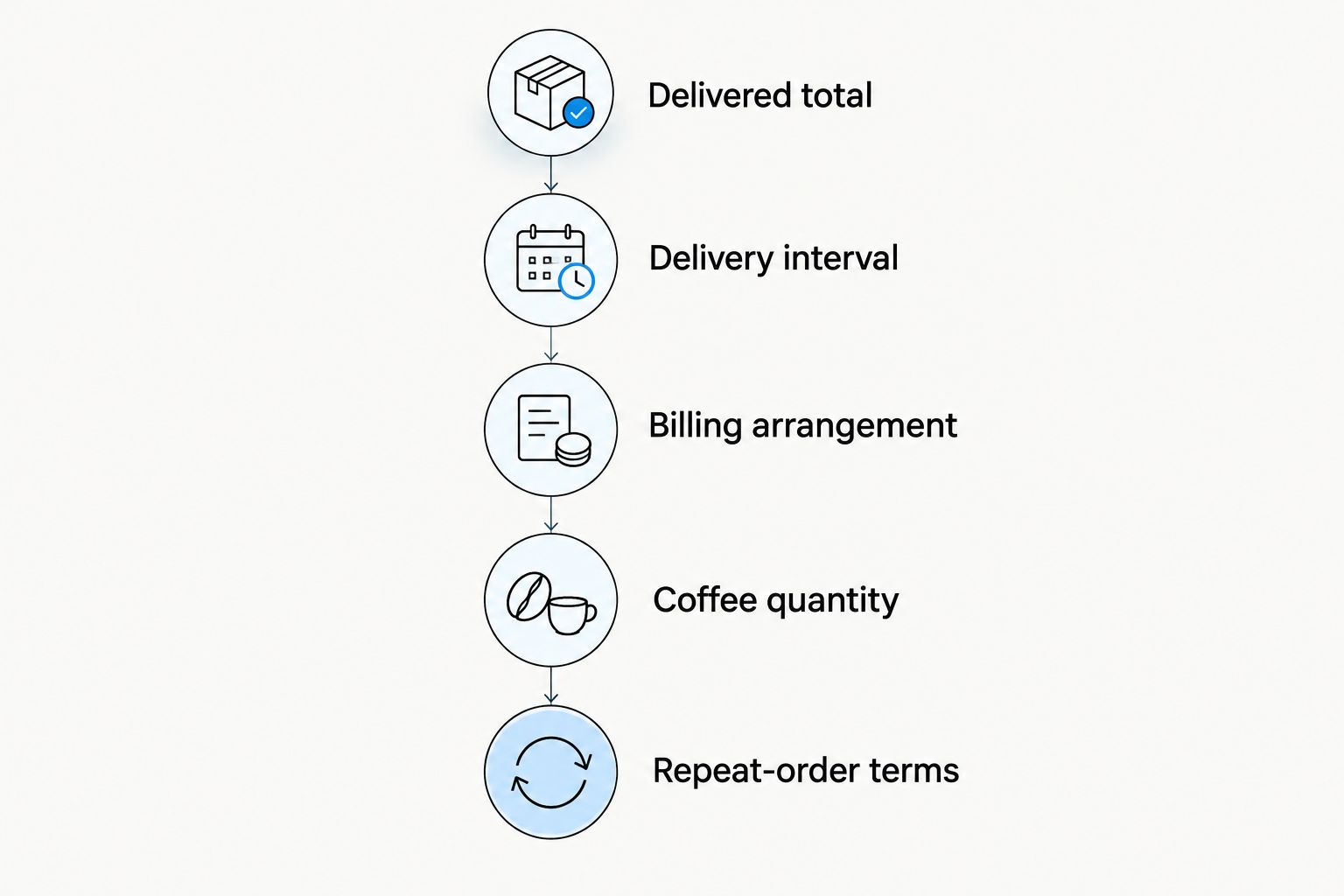
- Record the delivered total. Include the coffee, shipping, and applicable taxes shown for your address. Keep optional extras separate so they do not distort the recurring baseline.
- Record the delivery interval. Write down when orders repeat and whether you choose that interval. Check the first shipment and subsequent shipments separately.
- Count deliveries in your budget period. Use the actual schedule for your monthly or annual budget. A repeating weekly interval and a calendar-month schedule are different arrangements.
- Check the billing arrangement. Establish whether you pay as orders ship or pay ahead for a defined term. A payment covering several shipments is not a single-shipment charge.
- Divide by comparable coffee quantity. Use net weight for beans or ground coffee, and confirmed pod count for pods. Do not compare a bag with a box solely by their package names.
- Check the repeat-order terms. Read how future charges are determined and what you must do to change or end the arrangement. Save the terms you accept.
The useful calculation is simple: delivered spending divided by coffee quantity gives your delivered cost per unit. For personal budgeting, divide the same spending by the brews you actually make from that coffee.
A per-brew calculation is only useful when your brewing habits stay comparable. Use your own dose and finished brews rather than treating every mug, espresso, or cold-brew serving as equivalent. This is a household calculation, not a universal yield claim.
Which coffee-buying arrangement fits your routine?
A recurring order, a prepaid arrangement, and a one-time purchase solve different problems. Compare the arrangement as well as the coffee; convenient delivery does not automatically mean a better fit for your household.
| Arrangement | Best for | Main benefit | Main tradeoff | Check before choosing |
|---|---|---|---|---|
| Recurring order | Predictable home coffee use | Reorders follow an agreed schedule | The schedule needs attention when your consumption changes | Billing terms, delivery interval, and change deadlines |
| Prepaid arrangement | Buyers who want a defined purchase term | Payment covers the agreed arrangement upfront | You commit before consuming all the coffee | Shipment quantity, term length, and refund terms |
| One-time purchase | Irregular consumption or flavor testing | You decide when to order again | You handle each reorder yourself | Package weight and delivered checkout total |
These are purchasing formats, not claims that every retailer offers every option. Check which arrangement the seller actually provides before comparing it with another offer.
Choose a recurring order for predictable consumption; choose one-time purchases when your routine changes often. Neither format wins without reference to how you brew, how often you travel, and how much coffee remains when the next order is due.
What should a prepaid coffee buyer check?
A prepaid coffee arrangement needs a clear shipment schedule and a clear end point. Confirm whether the arrangement ends automatically or renews, and read the cancellation and refund terms before paying.
For a gift, also establish who controls shipment changes. The person paying and the person receiving the coffee have different roles, and the order terms should explain which person can make adjustments.
Why coffee subscription spending varies
The practical comparison in 2026 is the same coffee quantity delivered on the same schedule, with the full checkout charge included. These factors explain why apparently similar offers need closer inspection:
- Package weight. A package name does not tell you its net coffee content. Compare the labeled weight before comparing order totals.
- Coffee format. Beans, ground coffee, and pods use different quantity measures. Choose a format your brewing equipment supports, then compare like with like.
- Delivery frequency. The interval determines how often a shipment enters your home. If billing follows each delivery, it also determines how often you incur the order charge.
- Shipping destination. Use the total calculated for your address rather than a general product-page figure. Do not assume a shipping policy applies to your order without checking its conditions.
- Billing terms. An upfront purchase and a pay-per-shipment arrangement place spending in different parts of your budget. Read renewal terms as carefully as the initial order.
- Coffee consumption. Your brewing dose and actual use determine how long a delivery lasts. Unused coffee makes an apparently attractive recurring order a poor household fit.
Do not rank single-origin coffee, blends, flavored coffee, and decaf by assumed expense. Compare their actual checkout totals and labeled quantities. A category label alone does not establish the delivered cost or the taste you will prefer.
How do you choose coffee before scheduling repeat purchases?
God’s Country Coffee Co. is best for home coffee shoppers who want to compare blends, flavored coffee, single-origin coffee, pods, and tea. Its stated range gives you several coffee formats to consider; it does not establish a subscription schedule or subscription terms.
The God’s Country Coffee Co. catalog includes sample packs for buyers who want to try coffee before deciding what to reorder. Sampling addresses a different question from subscription budgeting: whether you want to drink that coffee repeatedly.
Two relevant options illustrate that distinction:
| Sample pack | Best for | What the description establishes | Limitation |
|---|---|---|---|
| Single Origin Favorites Sample Pack | Comparing single-origin coffees | Six packs containing 2 oz each | A tasting assortment does not establish recurring delivery terms |
| Flavored Coffees Sample Pack | Comparing flavored coffees | Six packs containing 2 oz each | A flavored assortment is not a substitute for testing an unflavored preference |
Each listed assortment contains 12 oz total, calculated from 6 packs of 2 oz each. Those are sample-pack quantities, not subscription allowances or claims about how many cups every brewer will produce.


Use the same brewer and preparation method when comparing samples. Write down which coffees you would choose again, rather than assuming that liking an assortment means you want every coffee in it on repeat.
The advantage of God's Country Coffee Co. sample packs is a defined tasting assortment. The limitation is equally clear: a sample pack does not tell you the terms, quantity, or timing of any future purchase. Evaluate those separately.
Is a coffee subscription cheaper than buying individual bags?
A coffee subscription is cheaper only when its delivered cost for a comparable quantity is lower than the one-time alternative. Compare the same coffee format, equivalent weight, destination, and currency before making that judgment.
Then check whether you will use the full delivery. A lower unit cost does not improve your household budget if the order adds coffee you would not otherwise buy. Compare spending for coffee you will consume, not just the largest quantity you can order.
How much coffee should I have delivered?
Your delivery quantity should match the coffee you actually use between shipments. Weigh your usual dose, track your brewing routine, and compare the resulting consumption with the package’s labeled net weight.
For pods, use the confirmed pod count and your actual brewing frequency instead. Do not convert a bag into an assumed number of servings unless you also specify the dose used for that calculation.
What should I check before my next recurring charge?
Check the next billing date, shipment quantity, delivered total, and any deadline for changing the order. For a 2026 purchase, read the terms presented when you enroll rather than relying on a general subscription guide.
If you need a change, follow the seller’s documented process and keep the confirmation. Do not assume that editing an account preference changes an order already being processed.
FAQ
How much does a coffee subscription cost in 2026?
A coffee subscription’s cost is its delivered charge multiplied by the number of deliveries in your chosen budget period. Compare the final checkout total, net coffee quantity, delivery schedule, and billing terms rather than treating an advertised coffee amount as the full expense.
Is a monthly coffee subscription the same as delivery every few weeks?
A monthly schedule and a repeating week-based schedule are different arrangements. Use the actual shipment dates to count deliveries and check whether billing follows those shipments.
Is shipping included in a coffee subscription?
Shipping is included only when the seller’s terms and your checkout total confirm it. Check the charge for your delivery address and selected order rather than assuming a general shipping statement applies.
Are coffee subscriptions better than one-time purchases?
Coffee subscriptions fit predictable consumption; one-time purchases fit irregular consumption and flavor testing. Compare the delivered quantity and the work required to manage each arrangement before choosing.
How do I compare coffee bags with coffee pods?
Compare bags by net weight and pods by confirmed pod count, then relate each format to your own brewing routine. Do not assume that a bag and a pod box produce equivalent servings.
Can I skip a coffee subscription delivery?
You can skip a delivery only if the subscription’s terms provide that option. Check the change deadline, follow the seller’s process, and confirm that the requested change was accepted.
Should I try a sample pack before repeating a coffee order?
A sample pack suits buyers who have not chosen a coffee they want to drink repeatedly. God's Country Coffee Co. lists single-origin and flavored sample assortments, each containing six 2 oz packs; those quantities do not establish subscription terms.
One last thing
Count the deliveries before you compare the deal. A familiar-looking recurring amount can distract you from how often it is charged, and a shipment interval is not automatically a calendar-month budget.
Before accepting a coffee arrangement in 2026, write down its delivered total, quantity, next billing date, and change deadline together. If those details do not fit your routine, choose a different schedule or make a one-time purchase instead.