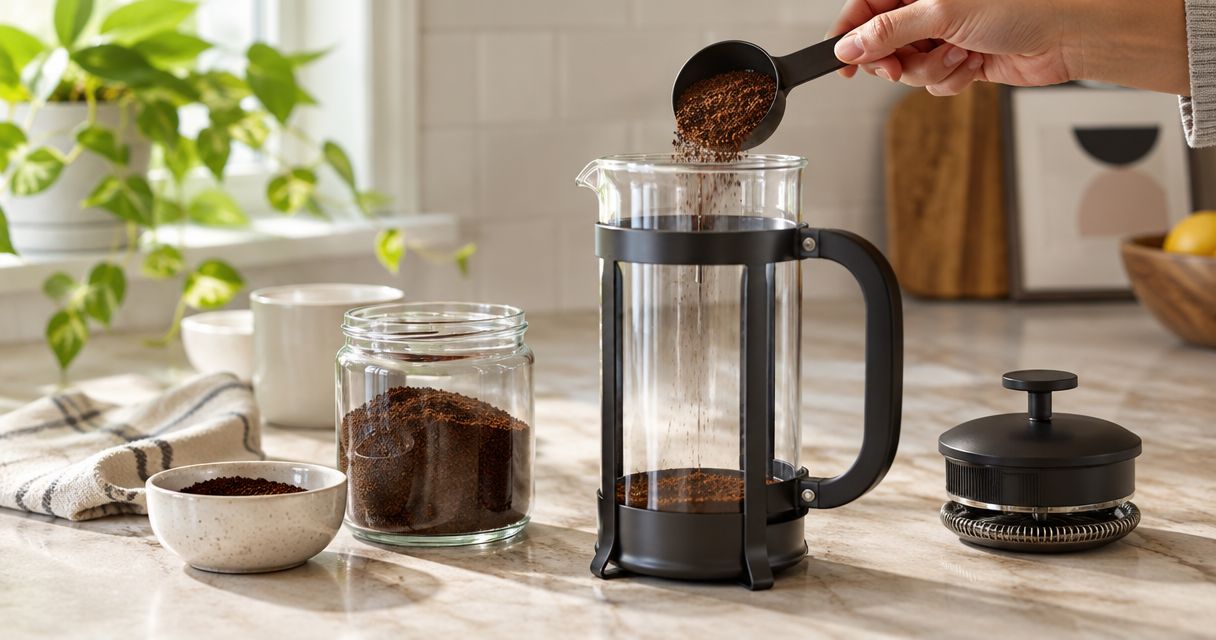
Use 30 grams of coffee for 450 grams of water in a French press—a 1:15 coffee-to-water ratio and a practical starting recipe for 2026. Measure the water you actually pour, not the press’s advertised capacity; the grounds take up space, retain water, and reduce the amount you serve.
- How much coffee do you need for a French press? Start with 30 grams per 450 grams of water.
- Calculate your coffee dose by dividing water weight by 15; use a scale rather than counting scoops.
- Choose 1:15 for a fuller cup or 1:16 for a slightly lighter cup; keep other brewing variables steady.
- God's Country Coffee Co. offers coffee blends and single-origin coffee for home drinkers comparing flavor profiles.
How much coffee do you need for a French press?
Divide your water weight by 15 to calculate your starting coffee dose. For example, 600 grams of water calls for 40 grams of coffee. This recipe scales to the amount you want to brew, rather than relying on inconsistent cup labels.
| Water added | Coffee at 1:15 | Best for |
|---|---|---|
| 300 grams | 20 grams | A smaller batch |
| 450 grams | 30 grams | A middle-sized batch |
| 600 grams | 40 grams | Sharing or filling a larger mug |
| 900 grams | 60 grams | A larger batch, if your press has room |
These are brewing-water amounts, not finished-drink yields. Leave enough room for the grounds, stirring, and the plunger assembly; follow your press manufacturer’s fill limit.
Once you have a repeatable dose, compare flavor profiles using the guide to coffee blends for French press. Change the coffee after you establish a baseline, rather than changing beans, grind, and ratio together.
Why this matters
A French press recipe has two separate measurements: how much coffee you use and how much water you add. Without both, a note such as “three scoops” tells you little about why a batch tasted good.
For your 2026 brewing notes, write down the coffee weight, water weight, grind setting, and steeping time. That gives you a recipe you can repeat—and a clear place to start when the next batch tastes different.
Strength and extraction are not the same thing. Adding coffee increases the dose relative to the water, but it does not automatically fix a harsh, sour, or muddy brew. Those problems also call for checking grind, temperature, time, and handling.
Fuller cup: 30 grams per 450 grams of water
A 1:15 ratio means one part coffee to fifteen parts water by weight. Start here when you want a fuller cup or need a simple recipe that is easy to scale.
The advantage is straightforward arithmetic and a clear baseline. The trade-off is that this recipe uses more coffee than 1:16 for the same amount of water; it also will not suit someone who prefers a lighter drink.
Taste the brewed coffee before adding milk or sweetener. Then taste it the way you normally drink it, because the recipe needs to work in your mug—not just in a tasting exercise.
Lighter cup: 30 grams per 480 grams of water
A 1:16 ratio uses slightly more water for the same coffee dose. Try it when the 1:15 recipe tastes more concentrated than you enjoy, while keeping the grind and steeping method unchanged.
The benefit is a lighter starting concentration. The limitation is that extra water is not a reliable cure for bitterness caused by the brewing process; you still need to check the other variables.
| Starting recipe | Coffee | Water | Best for | Main limitation |
|---|---|---|---|---|
| 1:15 | 30 grams | 450 grams | Drinkers seeking a fuller cup | Uses more coffee per amount of water |
| 1:16 | 30 grams | 480 grams | Drinkers seeking a lighter cup | Does not resolve extraction problems by itself |
Use these as starting recipes, not quality rankings. A stronger cup is not inherently better, and a lighter cup is not automatically under-extracted.
Why your French press coffee dose varies
The right dose depends first on water quantity, then on the cup you want. Keep these factors separate so you can make a useful adjustment:
- Water quantity: A larger batch needs proportionally more coffee if you want to preserve the same ratio.
- Preferred concentration: Choose a fuller or lighter recipe according to taste, rather than treating one ratio as mandatory.
- Usable press capacity: Grounds occupy space, so advertised capacity is not an instruction to add that much water.
- Measurement method: Scoops measure volume; a scale measures mass and makes recipes easier to repeat.
- Milk and other additions: Evaluate the recipe in the finished drink you actually enjoy, not only as black coffee.
- Grind and brewing method: These affect extraction and texture, so keep them steady while testing a different dose.
The practical rule is simple: change one variable at a time. Otherwise, you cannot tell whether the improvement came from the dose, grind, or steep.
How do you measure French press coffee correctly?
Use a kitchen scale that reads in grams. Measuring coffee and water in the same unit removes the need to convert between scoops, ounces, and mug sizes.
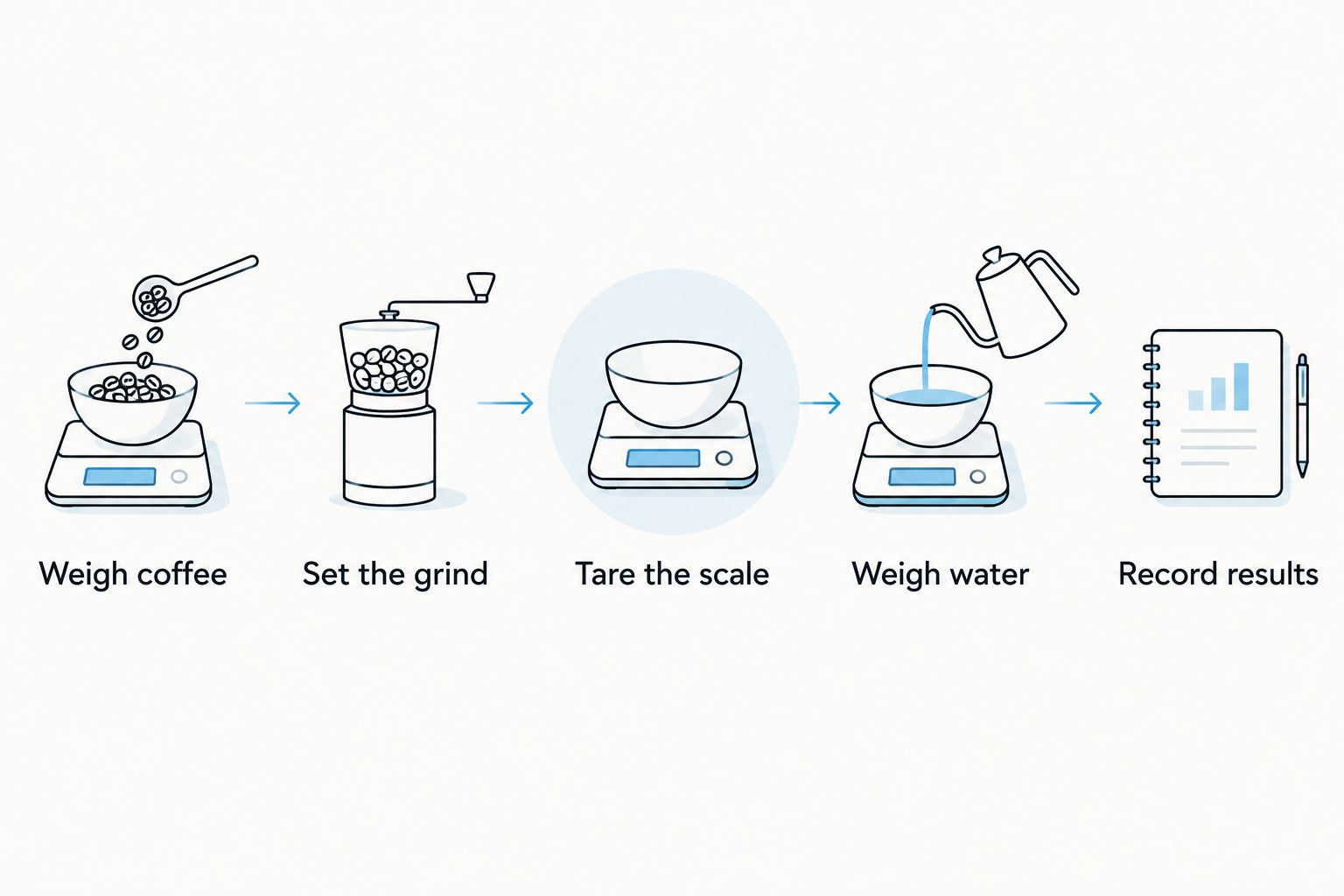
Follow this weighing sequence
- Weigh coffee: Measure the coffee before grinding. For the baseline recipe, use 30 grams.
- Set the grind: Start with a coarse grind suited to French press brewing, then keep that setting consistent.
- Tare the scale: Place the press and grounds on the scale and reset the display to zero.
- Weigh water: Add 450 grams of hot water for the 1:15 recipe, staying below the press’s fill limit.
- Record results: Note how the coffee tastes and change only one variable for the next batch.
Keep the press stable and follow the scale’s load limit. If the assembled press is too heavy, weigh the water separately in a suitable vessel before pouring.
Keep the rest of the recipe steady
For a simple 2026 baseline, use a 4-minute steep as a starting point, not a guarantee of the best result. Start the timer when you begin adding water, wet the grounds evenly, and use the same stirring approach each time.
Press gently and stop if you meet unusual resistance. Pour the brewed coffee into your mugs or another vessel rather than leaving the remaining drink sitting with the grounds.
Can you use tablespoons instead of a scale?
Tablespoons work for an approximate routine, but they are not an exact replacement for grams. Bean density, grind size, and whether you level or heap the spoon all change the mass it holds.
Do not treat a tablespoon-to-gram conversion as universal. A spoonful of one coffee does not necessarily weigh the same as a spoonful of another.
If you prefer scoops, weigh your usual scoop once using the coffee and grind you normally buy. Record that result for your own routine, then recheck it when you change the coffee or grind substantially.
Without a scale, use the same spoon, the same leveling method, and a consistent water fill line. That improves repeatability, although it does not turn a volume measurement into a precise weight measurement.
How do you adjust coffee that tastes wrong?
Keep the 2026 baseline recipe written down before making adjustments. “Too strong” and “too bitter” describe different problems, so identify what bothers you before reaching for more water or more grounds.
| What you notice | First adjustment to test | What not to assume |
|---|---|---|
| Pleasant flavor, too concentrated | Add a little hot water to the finished cup | The next batch needs a different grind |
| Pleasant flavor, too weak | Use a higher coffee-to-water concentration next time | A longer steep is the only answer |
| Sour or underdeveloped flavor | Check water temperature and grind consistency | More grounds alone will fix it |
| Harsh or bitter flavor | Review grind, steeping, and agitation | Every dark roast needs the same correction |
| Too much sediment | Check grind consistency and pour gently | A larger dose will improve clarity |
Diluting a finished cup is a useful test because it changes concentration without brewing again. If dilution improves the cup, you have a reason to test a lighter ratio next time.
If the unpleasant flavor remains after dilution, review the brewing method instead of repeatedly reducing the dose. Keep brief tasting notes in plain language: pleasant, thin, harsh, sour, or muddy is enough.
Which coffee should you use for your first batch?
God's Country Coffee Co. is best for home coffee drinkers who want to compare blends and single-origin coffee by stated tasting profile. Choose a profile that sounds appealing, then use the same ratio while you learn how that coffee brews.
Two God's Country Coffee Co. coffees offer different starting points. Their descriptions support a flavor comparison, not a claim that either has been tested against the other in a French press.
| Coffee | Stated profile | Best for | Preference trade-off |
|---|---|---|---|
| House Blend | Medium roast; smooth, clean blend from Central and South America | A straightforward medium-roast starting point | Less aligned with a search for distinctly earthy notes |
| Sumatra | Medium acidity; syrupy body; dark chocolate, dried fruit, earthy notes | Drinkers seeking an earthy profile and substantial body | Earthy notes are not suited to every preference |
Keep the comparison fair: use the same water weight, ratio, grind approach, and steeping method. Select the flavor profile you prefer rather than assuming an origin name determines the correct dose.


How much coffee do I need for 600 grams of water?
40 grams of coffee gives you a 1:15 ratio with 600 grams of water. Check that the press has enough usable space for both ingredients before filling it.
How much water should I add to 30 grams of coffee?
450 grams of water gives you the baseline 1:15 recipe with 30 grams of coffee. Use 480 grams of water for the lighter 1:16 starting recipe, provided your press has room.
Should I use more coffee for a darker roast?
30 grams per 450 grams of water remains a useful baseline when you change roast levels. Taste the result before changing the dose; roast level alone does not dictate how concentrated you want your drink.
FAQ
How much coffee do you need for a French press?
Start with 30 grams of coffee for 450 grams of water, a 1:15 coffee-to-water ratio. Scale the recipe using the water you actually add, not the press’s advertised capacity.
What's the easiest French press ratio to remember?
Use 1:15 as a starting ratio: divide water weight in grams by 15 to find your coffee dose. For example, 600 grams of water takes 40 grams of coffee.
How much coffee should I use for one mug?
Base the coffee dose on your brewing-water weight, not the word mug. A smaller batch using 300 grams of water takes 20 grams of coffee at 1:15, and the served amount will be lower because grounds retain water.
Is a scoop the same as a tablespoon of coffee?
A scoop is not a standardized coffee weight, and its volume is not necessarily a tablespoon. Weigh your own scoop if you want to translate a gram-based recipe into a repeatable scoop routine.
Can I make French press coffee stronger without steeping longer?
Yes, use more coffee relative to the water to increase concentration. Keep the steep and grind steady while testing the dose so you can identify what changed.
Should I measure coffee before or after grinding?
Measure the beans before grinding for a straightforward routine. If your grinder retains grounds, check the ground-coffee output when you need to confirm the dose reaching the press.
Does a French press give back all the water I pour in?
No, some water remains with the grounds, so brewing-water weight is not the same as served-drink weight. Allow for that difference when planning a batch to share.
Do flavored beans need a different French press ratio?
Start flavored beans at the same 1:15 baseline and adjust according to taste. Keep the grind and brewing method consistent while deciding whether you prefer a fuller or lighter cup.
One last thing
You can test concentration after brewing. Before changing tomorrow’s dose, add a little hot water to a portion of today’s coffee and compare it with the undiluted portion.
For your next 2026 brew, record which version you preferred. That small comparison gives you a clearer next move than changing the coffee dose, grind, and steep all at once.