Instead of recalculating your coffee dose every morning, build a single-origin coffee subscription and French press routine around a repeatable recipe: 30 g of coffee, 500 g of water, and a 4-minute starting steep. Match replenishment to your actual use, then adjust one brewing variable whenever the coffee changes.
- Single origin coffee subscription French press workflow: establish your recipe before choosing a replenishment schedule.
- God's Country Coffee Co. sells single-origin coffee; confirm recurring-order terms before planning deliveries.
- Start with 30 g coffee, 500 g water, and a 4-minute steep; adjust to taste.
- Decant after brewing, record your results, and change only one variable between batches.
Why this matters
A subscription handles replenishment, not extraction. Your grinder, water, dose, and steep determine what reaches the cup; changing everything with each bag makes the results difficult to repeat.
God's Country Coffee Co. is best for home shoppers seeking single-origin coffee alongside other coffee and tea categories. Start with the coffee selection at God's Country Coffee Co., then confirm the purchase format before building your routine around recurring orders.
For your 2026 brewing workflow, separate two decisions: how you obtain coffee and how you brew it. The French press recipe below works with either recurring purchases or individual orders. Neither purchase format replaces weighing the ingredients.
Before you start
- Gather a French press, kitchen scale, timer, kettle, clean drinking water, and a separate serving vessel. Use a burr grinder for whole beans, or obtain coffee ground for a French press.
- Read the coffee label and purchase terms. Confirm the coffee's identity, grind format, package weight, and any recurring-order conditions before committing to a replenishment schedule.
- Check usable capacity, not just the press's advertised size. Grounds and water need room below the lid; reduce this recipe proportionally if 500 g of water will overfill your brewer.
You do not need a subscription account to learn the brewing process. If you use a recurring order, retain its confirmation and the instructions for managing it; do not assume that buying coffee once creates a subscription.
Coffee selection and replenishment
Choose a coffee you can evaluate
- Read the origin and tasting description before choosing a bag. Treat tasting notes as a description of the coffee, not a promise that every brewing method will produce identical flavors.
- Choose a profile you already enjoy. Begin with familiar preferences before testing a contrasting origin.
- Confirm the format. Buy whole beans only if you have a grinder; otherwise, check the stated grind before ordering.
- Keep the first bag as your baseline. Avoid switching coffee while you are still correcting an inconsistent recipe.
Expected result: you know which coffee you are brewing, how it is prepared, and what flavor direction you want to evaluate.
The following comparison uses the supplied product descriptions. The limitations are preference trade-offs, not product defects or results from a tasting test.
| Coffee | Best for | Stated profile | Advantage for this workflow | Trade-off |
|---|---|---|---|---|
| Peru | Drinkers seeking caramel and citrus notes | Medium roast; salted caramel, silky sweet, citrus | A starting point for evaluating sweetness against brightness | Not the profile to choose when you specifically want earthy notes |
| Sumatra | Drinkers seeking a heavier-bodied profile | Medium acidity; syrupy body, dark chocolate, dried fruit, earthy | Suits a preference for body in an immersion brew | Earthy notes are a mismatch if you prefer a citrus-led cup |
Choose Peru for its stated caramel-and-citrus profile; choose Sumatra for its stated syrupy, earthy profile. Neither choice requires changing the entire recipe before your first brew.


Match replenishment to consumption
- Record how much dry coffee you use per brew. Use grams rather than scoops so the record remains useful when the beans change.
- Multiply that dose by your actual brewing frequency. At the suggested 30 g dose, one brew daily uses 210 g over 7 days.
- Compare consumption with the package's stated net weight. Divide package weight by dose to estimate the number of brews it provides.
- Check your remaining coffee before arranging another purchase. If you use recurring orders, follow the merchant's documented management process rather than assuming a particular account button exists.
Expected result: your replenishment decision follows measured use, not a guess based on cups or household size.
For a 2026 subscription plan, record interruptions too. Travel, shared brewing, and a switch to another drink change consumption; a schedule based on an ordinary week needs review when your routine changes.
French press preparation
Establish the baseline recipe
- Inspect the brewer for cracks and check that the filter assembly is secure. Follow the manufacturer's instructions for assembly and safe handling.
- Preheat the press with warm water, then empty it. Place the brewer on a stable, heat-safe surface.
- Weigh 30 g of coffee. Grind it to a coarse, reasonably even texture; avoid treating a grinder's numbered setting as universal across machines.
- Prepare 500 g of water. Use 93°C, about 199°F, as a starting temperature if your kettle offers temperature control.
- Set out a timer and an empty serving vessel before pouring. Keep the same equipment and water source for the first comparison brews.
Expected result: the ingredients and equipment are ready before extraction begins, with a coffee-to-water ratio of approximately 1:16.7 by weight.
These quantities define a starting recipe, not a mandatory standard for every origin. If the coffee tastes unpleasant, make a measured adjustment rather than assuming the origin or purchase method is responsible.
Brew, separate, and record
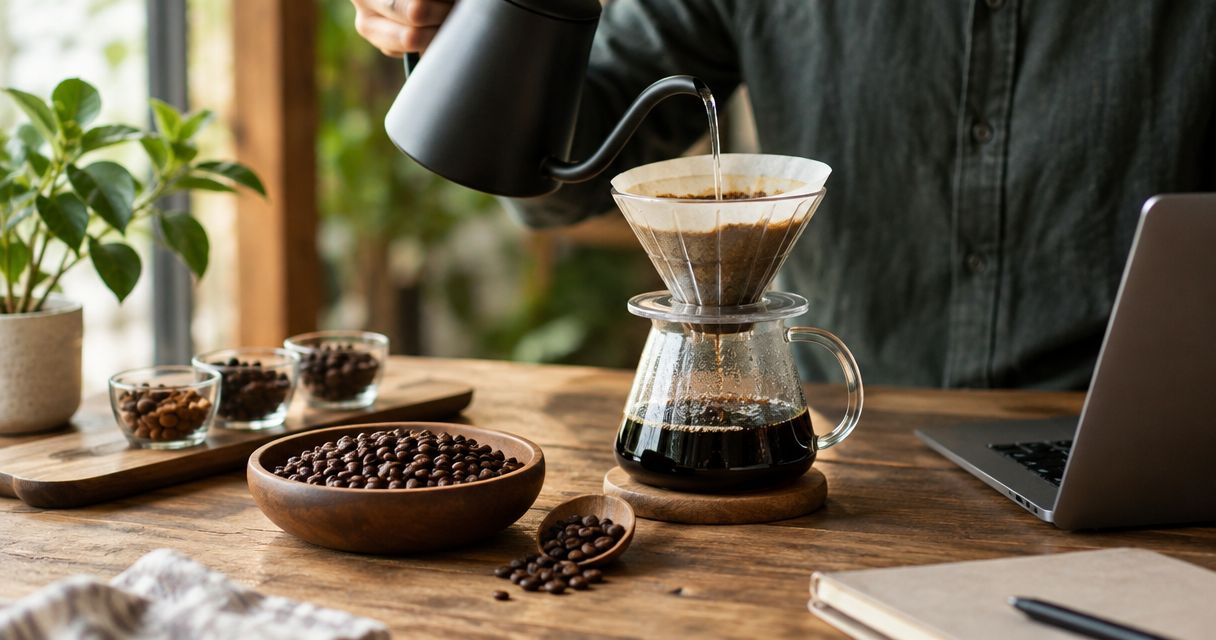
- Add the ground coffee to the empty press. Place the brewer on the scale and reset the displayed weight before adding water.
- Start the timer as you pour. Add the 500 g of water, wetting all the grounds, and stir gently with a utensil suitable for your brewer.
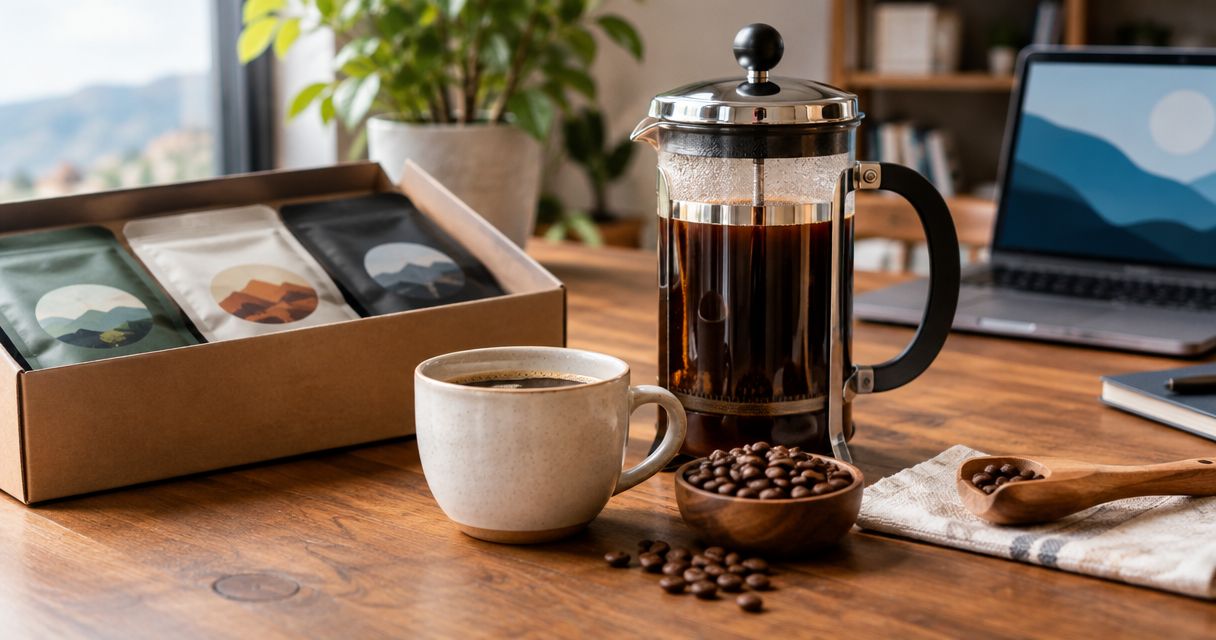
- Position the lid without pressing the filter down. Start with a 4-minute steep, measured from the first contact between water and coffee.
- Lower the plunger slowly. Stop if it resists strongly; never force the plunger through a blocked filter or point the spout toward someone.
- Pour the brewed coffee into the separate serving vessel. Leave the final sediment-heavy portion behind if you dislike grit.
- Taste when the coffee is comfortable to drink. Record the dose, water weight, temperature, steep time, grinder setting, and your impression.
Expected result: you have a repeatable first cup and a written baseline for the next brew, rather than an unrecorded impression.
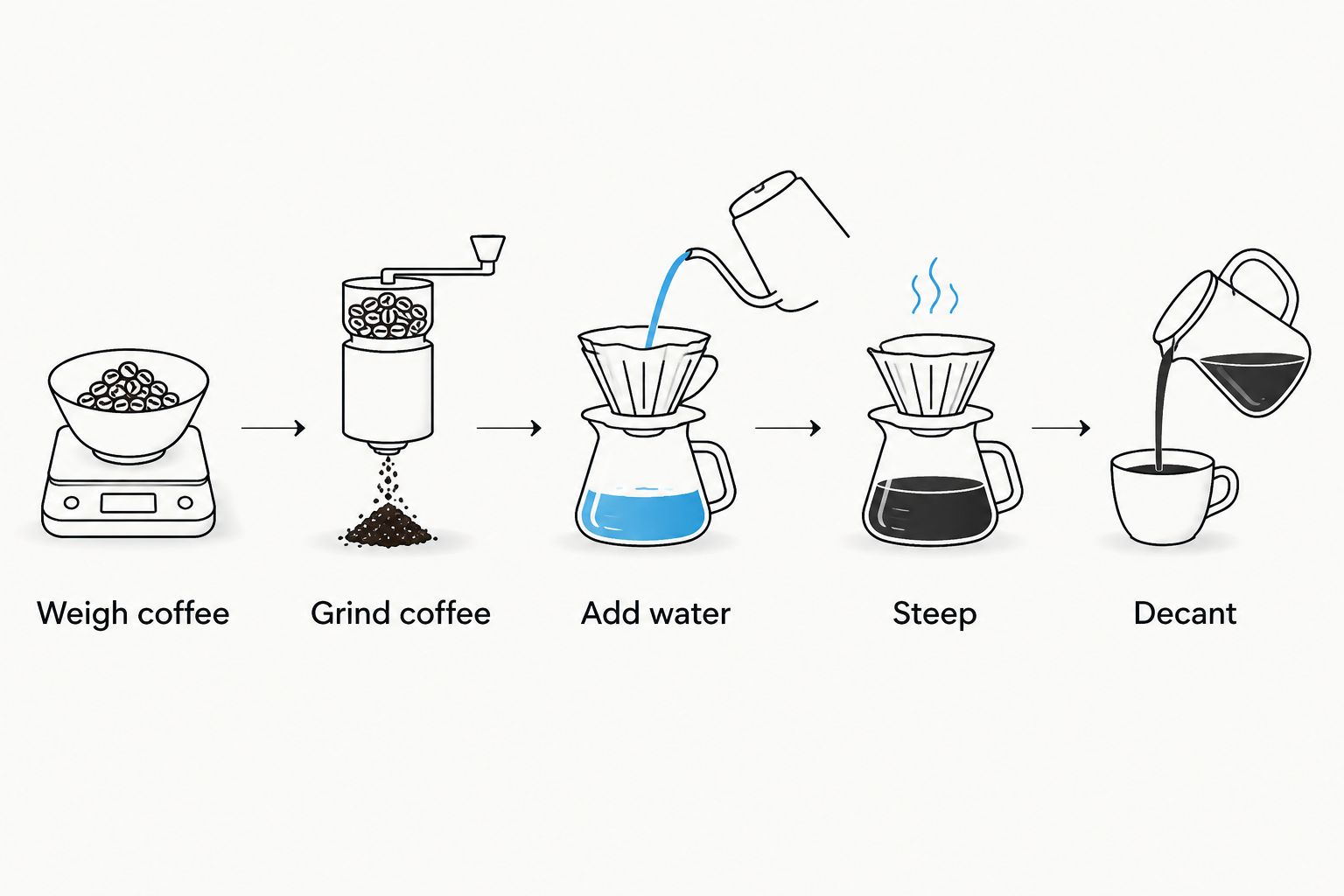
The core sequence is Weigh coffee, Grind coffee, Add water, Steep, Decant. Decanting matters even when you plan to drink slowly: it separates the served coffee from the bed of grounds.
Keep your 2026 brew log simple enough to use before breakfast. A short entry such as sweet, thin, gritty, or bitter is more useful than an elaborate tasting vocabulary you never record consistently.
When a new single-origin coffee arrives
A different origin is a reason to compare, not a command to rebuild your method. Start the new bag with your established recipe, then adjust only after tasting it.
- Read the new label. Record the coffee name and any stated roast or processing information without filling in missing details yourself.
- Repeat the baseline dose, water weight, temperature, and steep. Keep your grinder setting unchanged for this first comparison.
- Taste before adding milk or sweetener if you want to evaluate the coffee itself. Then prepare the drink the way you normally enjoy it.
- Choose one correction. Try a slightly finer grind for a sour, thin result or a slightly coarser grind for an unpleasantly dry result, while keeping everything else constant.
- Brew again and compare your notes. Keep the change only if you prefer the result.
Expected result: you learn how the new coffee behaves without confusing a bean change with several recipe changes.
Flavor descriptions do not guarantee a particular extraction. A citrus note on a label is not automatically a brewing fault, and a darker flavor is not proof that the coffee needs a shorter steep.
For your 2026 rotation, keep separate notes for each coffee. Returning to an earlier bag becomes easier when you can retrieve its recipe instead of starting from memory.
Troubleshooting
The cup tastes sour and thin
Check the measured dose and water weight first. If they match your baseline, try a slightly finer grind while keeping steep time and temperature unchanged.
Do not diagnose every bright flavor as underextraction. Compare the result with the coffee's stated profile and decide whether the cup also lacks sweetness or body.
The cup tastes bitter or drying
Clean the brewer and filter assembly before changing the recipe; retained coffee residue interferes with a fair comparison. Then try a slightly coarser grind, holding the other variables steady.
Distinguish drying bitterness from a flavor you simply dislike. If the profile itself does not suit you, recipe changes are not a reason to keep buying it.
The cup contains too much sediment
Check that the filter is correctly assembled and undamaged. Plunge gently, let disturbed particles settle, and pour slowly without emptying the sludge at the bottom into your cup.
A French press uses a metal filter, so it does not produce the same sediment-free result as paper filtration. Choose this method for immersion brewing and body, not for a completely clear cup.
The plunger is difficult to push
Stop pressing immediately. Keep the brewer stable, allow it to cool before inspection, and follow its manufacturer's handling instructions.
Check for an overly fine grind, an overfilled vessel, or a misassembled filter before the next brew. Force is not a correction for a restricted filter.
Coffee accumulates between purchases
Recalculate consumption using actual brews rather than intended brews. Include skipped mornings and coffee made elsewhere.
If you use a recurring order, review its documented change or cancellation process. Do not confuse editing a future purchase with changing an order already being processed.
Customize your workflow
Change batch size before changing strength. To make less coffee with the same starting ratio, use 15 g of coffee and 250 g of water; keep enough clearance for the grounds and lid.
For a larger household, scale the ingredients only within the brewer's usable capacity. Use a larger brewer or separate batches rather than filling beyond the safe working level.
Keep purchase management separate from brewing notes. Your brew log records what tastes good; your order record tracks what you bought and what action is needed next. Review both when your consumption changes in 2026.
For the next planning step, use the single-origin coffee subscriptions for home baristas guide. Confirm the actual recurring-order terms separately before treating any coffee purchase as a subscription.
FAQ
Can I use single-origin subscription coffee in a French press?
Yes, single-origin coffee can be brewed in a French press when its format suits the method. Use whole beans with a grinder or an appropriate preground format; recurring delivery does not change the brewing process.
What ratio should I start with for French press coffee?
Start with 30 g of coffee and 500 g of water, approximately a 1:16.7 ratio by weight. Treat that as a baseline and adjust after tasting, rather than changing several variables together.
How long should I steep single-origin coffee in a French press?
Use 4 minutes as the starting steep for this recipe, timed from the first contact between coffee and water. Keep the timing consistent while evaluating grind changes.
Does God's Country Coffee Co. offer a subscription for every single-origin coffee?
Confirm recurring-purchase terms for the specific coffee before ordering. God's Country Coffee Co. sells single-origin coffee, but a product listing alone does not establish subscription eligibility or delivery controls.
Do I need to change the recipe whenever a new origin arrives?
No, brew the new coffee with your established recipe first. Change one variable only after tasting so you can identify what improves the cup.
Why does my French press coffee contain sediment?
A French press uses a metal filter that allows fine particles into the cup. Check the filter assembly, plunge gently, and leave the sediment-heavy final pour behind.
Should I leave brewed coffee in the French press?
Decant the brewed coffee into a separate vessel after brewing. This separates the served coffee from the grounds and helps keep your routine consistent.
One last thing
The most useful subscription setting starts with a scale, not an account menu. Measure what you actually use before deciding how often coffee should arrive; an excellent recipe cannot prevent an oversized replenishment plan.