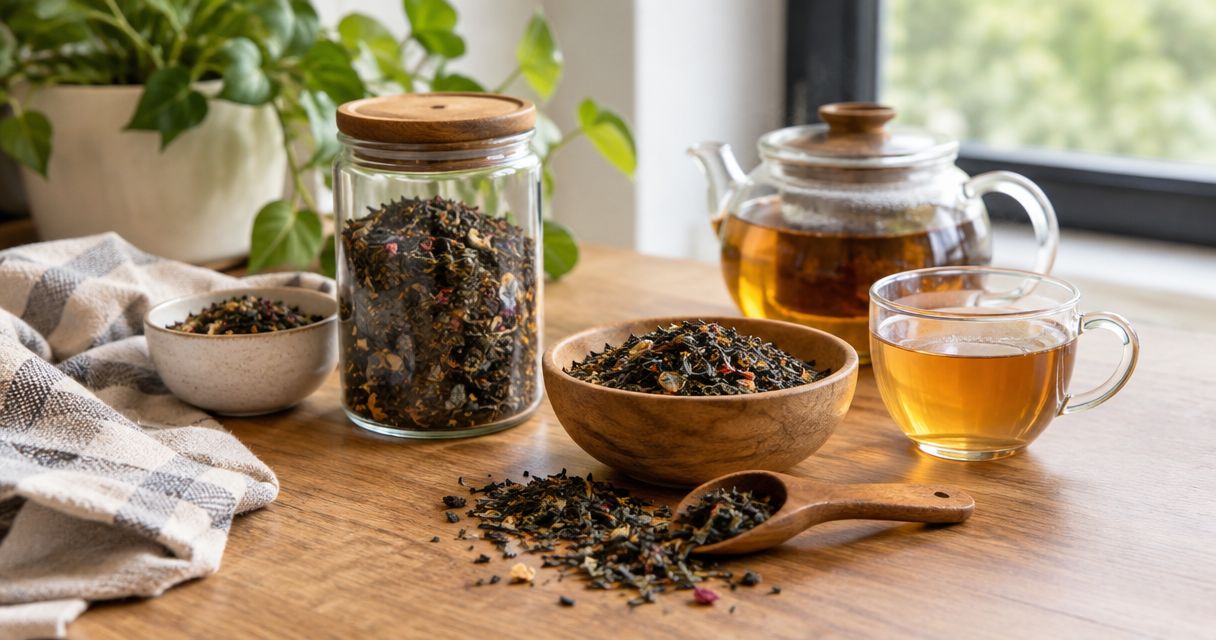
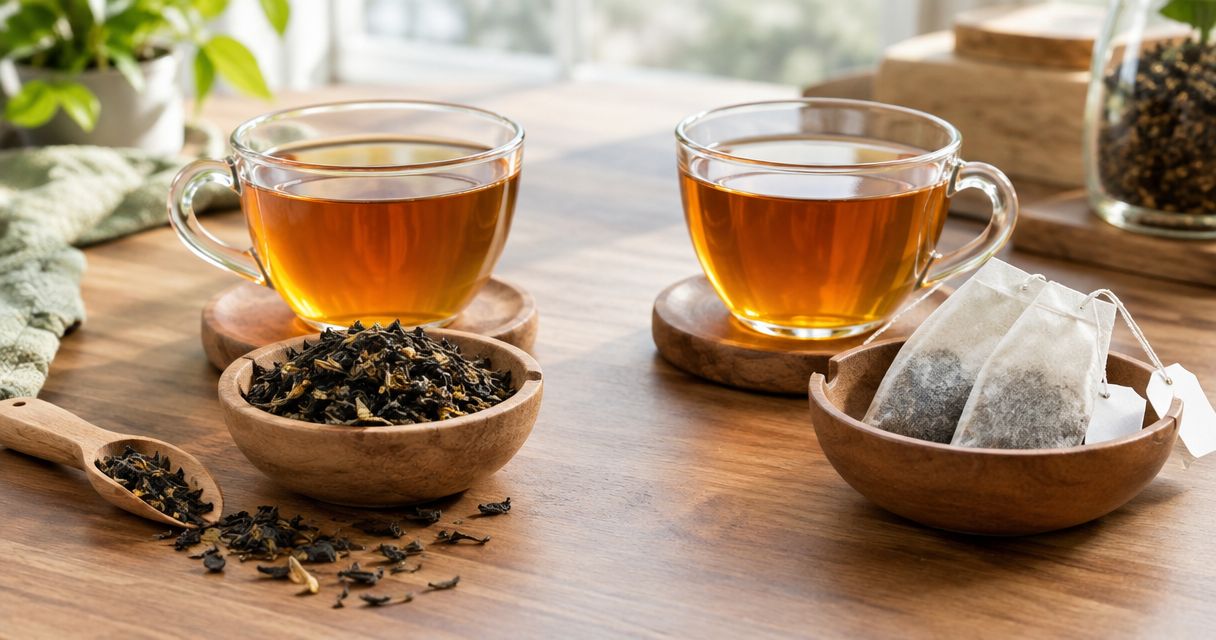
Loose leaf tea is not automatically healthier than tea bags: the tea itself, how you brew it, and what you add matter more than the format. Both can provide tea polyphenols, while either can contain caffeine; loose leaves offer more control over the serving, but they do not guarantee greater health benefits. This 2026 guide separates those health questions from differences in flavor, convenience, and packaging.
- Is loose leaf tea healthier than tea bags? Not automatically; ingredients and brewing matter more than format.
- Green tea and black tea contain polyphenols whether brewed loose or in bags.
- Loose leaf tea offers portion control; tea bags offer convenient, repeatable preparation.
- Choose verified bag materials if packaging concerns you, rather than assuming every tea bag contains plastic.
Why this matters
A switch from bags to loose leaves changes your brewing routine. It does not, by itself, establish that you are drinking less caffeine, consuming fewer contaminants, or getting more beneficial compounds.
Choose the tea for your needs, then choose the format you will actually use. If an infuser feels inconvenient, a tea bag is a reasonable alternative—not a failed health choice. For practical setup help, follow this guide to an electric kettle and infuser routine.
Is loose leaf tea healthier than tea bags?
Neither format wins on health alone. Green and black tea come from Camellia sinensis, and both loose leaves and bagged versions can release polyphenols into water. Comparing an unspecified loose tea with an unspecified tea bag does not tell you which brewed cup contains more.
The useful comparison is between similar teas prepared under similar conditions. Leaf quantity, water volume, temperature, and steeping time all affect the result.
| Question | Loose leaf tea | Tea bags |
|---|---|---|
| Best for | Adjusting portions and exploring leaf styles | Quick preparation and simpler cleanup |
| Does it contain polyphenols? | Yes, when made from tea leaves | Yes, when made from tea leaves |
| Is it automatically lower in caffeine? | No | No |
| How much control do you have? | You measure the leaf portion | The bag contains a preset portion |
| Main practical advantage | You can change the leaf-to-water ratio directly | You can repeat the same preparation easily |
| Main practical drawback | Requires measuring and straining | The portion and bag construction limit adjustments |
| Packaging consideration | A reusable infuser avoids a disposable brewing bag | Materials differ and need checking |
For a 2026 buying decision, treat format as a preparation preference rather than a health certification. A well-chosen bagged tea can suit your needs better than a loose blend with ingredients you need to avoid.
Do loose tea leaves contain more antioxidants?
Loose tea leaves do not automatically deliver more antioxidants in the cup. Tea polyphenols include compounds with antioxidant activity, but the amount extracted depends on the leaf material and the brewing conditions—not simply whether a bag surrounds it.
Smaller tea particles expose more surface area to water. That can help compounds extract quickly; it does not mean smaller leaves are nutritionally worthless. Conversely, a large intact leaf is not proof of a higher antioxidant concentration in the finished drink.
Do not use leaf size as a substitute for evidence about the brewed tea. The appearance of dry leaves tells you something about their physical form, not the health outcome you will get from drinking them.
There is also a difference between measuring antioxidant activity in a laboratory and demonstrating a benefit in people. A claim about a tea's chemical composition is not automatically a claim about disease prevention. Neither loose tea nor tea bags should be treated as a medical treatment.
Does loose leaf tea have less caffeine?
Loose leaf tea is not inherently lower in caffeine than tea bags. The tea variety, quantity of leaves, and brewing method influence how much caffeine reaches your cup.
A large infuser packed with leaves can produce a stronger serving than a lightly brewed bag. Switching formats without checking your portion can therefore work against a goal of reducing caffeine.
If caffeine is your concern, make the ingredient decision first:
- Choose a clearly identified caffeine-free herbal infusion when avoiding caffeine is the priority. Check the complete ingredients rather than relying on a calming name.
- Choose decaffeinated tea when you want tea-leaf flavor with less caffeine, while remembering that decaffeinated does not mean caffeine-free.
- Control the serving when drinking caffeinated tea. A larger mug or more leaves changes what you consume.
- Do not rely on a quick rinse to turn ordinary tea into a reliably decaffeinated drink.
For your 2026 routine, assess the whole day's caffeinated drinks rather than assuming a loose-leaf label solves the issue. If caffeine affects your sleep or symptoms, discuss your intake with a qualified healthcare professional.
Are tea bags unhealthy because of plastic?
Not every tea bag uses the same material. Paper, plastic-based mesh, and plant-derived materials are different constructions, so the phrase tea bag does not identify exactly what touches your water.
Some bag materials can release particles during brewing. However, finding particles and establishing the health effects of a particular exposure are different questions. Avoid claims that all tea bags are toxic or that switching to loose leaves prevents disease.
If your goal is to avoid disposable brewing-bag materials, use loose tea in a reusable stainless-steel infuser. That directly addresses the brewing container without promising an unproven medical benefit.
When choosing bags, check the manufacturer's material information. A mesh appearance does not identify the polymer, and a compostable claim does not necessarily mean plastic-free or suitable for your home compost.
Loose tea also comes in packaging. Replacing a tea bag does not eliminate every packaging or food-contact consideration, so keep the decision specific to the material you want to avoid.
Why the health comparison varies
The factors below explain why a universal loose-versus-bagged verdict fails. Use this checklist when comparing teas in 2026.
- Tea ingredients: Green tea, black tea, and herbal blends are not interchangeable. Check the actual plants and any added ingredients.
- Leaf quantity: More leaves change the amount of material available for extraction. A scoop is not a standardized dose across different leaf shapes.
- Brewing conditions: Water temperature and contact time affect extraction and taste. Follow the tea's directions before making adjustments.
- Serving size: A small cup and a large travel mug are different servings, even if each is called one cup.
- Added sweeteners: Sugar, honey, and syrups change the drink. Switching formats does not remove those additions.
- Bag materials: Construction varies by manufacturer. Read material disclosures instead of judging from the bag's shape.
These factors also explain why a darker-looking cup is not automatically healthier. Color reflects the tea and its preparation; it is not a direct measure of nutritional value or caffeine.
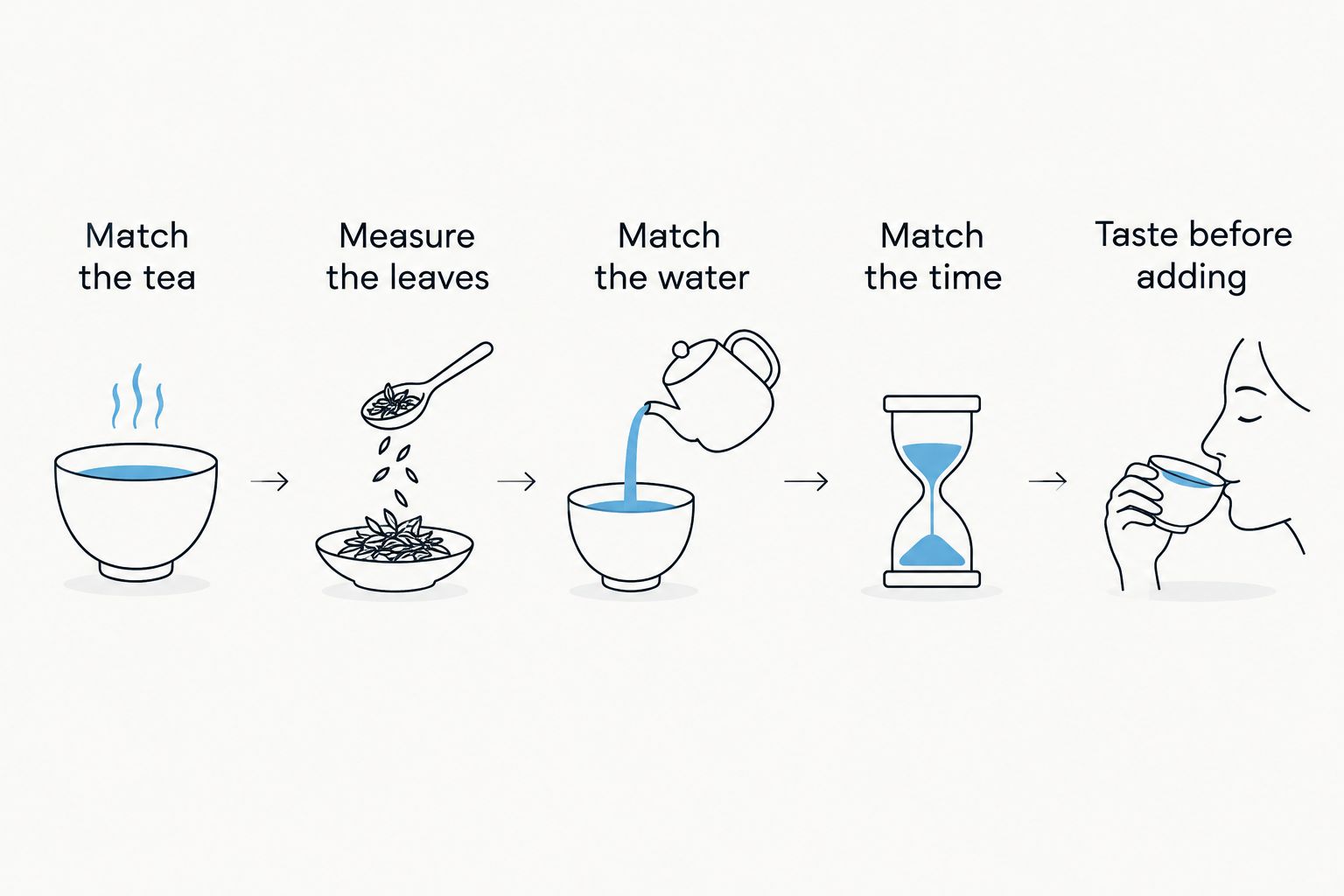
How can I compare loose tea and tea bags fairly?
Compare similar tea types, keep the preparation consistent, and change one variable at a time. This is a taste-and-routine comparison, not a home test of antioxidants or contaminants.
- Match the tea. Compare plain green tea with plain green tea, rather than a loose herbal blend with a bagged black tea.
- Measure the leaves. For an illustrative comparison, use 2 grams of dry tea for each serving where the package directions permit it. Check the bag's stated fill weight instead of assuming it matches.
- Match the water. Use 240 milliliters of the same water in each cup, with the same brewing temperature.
- Match the time. If both packages permit a 3-minute steep, use that duration for both. Otherwise, follow each package and acknowledge that the preparation differs.
- Taste before adding. Compare the drinks without sweeteners first, then decide which fits your routine.
These quantities create a repeatable example, not a universal brewing prescription. Different teas need different preparation, and your taste comparison cannot establish which drink produces better health outcomes.
Which tea should I choose for my daily routine?
God's Country Coffee Co. is best for home shoppers who want coffee and tea from one online retailer. That shopping fit does not establish a health advantage for its tea or for any particular brewing format.
For a specific ingredient choice, God's Country Coffee Co. lists Jasmine as a blend of green tea and jasmine blossoms, while Apple Cider Rooibos is described as naturally caffeine-free. Those descriptions help distinguish the drinks without turning either into a wellness claim.
| Tea | Best for | Supported description | Limitation to consider |
|---|---|---|---|
| Jasmine | A green-tea-based drink with floral character | Green tea blended with jasmine blossoms; described as suitable for multiple steepings | Green tea contains caffeine; this is not a caffeine-free choice |
| Apple Cider Rooibos | A naturally caffeine-free herbal alternative | Described as spicy, sweet, and naturally caffeine-free | It is an herbal alternative, not a green-tea substitute with an identical composition |
Choose between these God's Country Coffee Co. teas by ingredients and caffeine preference, not an assumption that one prevents illness. Check the complete product information and preparation directions before ordering.


Can I drink tea every day?
Daily tea drinking is not a reason by itself to choose loose leaves over bags. Consider caffeine tolerance, added ingredients, and your own medical circumstances rather than treating either format as universally suitable.
Herbal does not automatically mean appropriate for everyone. If you take medication, are pregnant, or have a condition affected by particular ingredients, ask a clinician or pharmacist about the actual blend. The brewing format does not answer that safety question.
FAQ
Is loose leaf tea healthier than tea bags in 2026?
Loose leaf tea is not automatically healthier than tea bags in 2026. Tea ingredients, serving size, brewing conditions, and additions matter more than the format alone.
Do tea bags still contain antioxidants?
Tea bags containing green or black tea can release polyphenols with antioxidant activity into the brewed drink. A bag does not remove these compounds, and loose leaves do not guarantee a higher amount.
Does loose leaf tea have less caffeine?
Loose leaf tea does not inherently have less caffeine than bagged tea. The tea itself, leaf quantity, and preparation determine the caffeine in your serving.
Are all tea bags made with plastic?
Not all tea bags use the same materials, so you cannot assume every bag contains plastic. Check the manufacturer's description of the bag and its sealing materials.
Is herbal tea healthier than green tea?
Herbal tea is not automatically healthier than green tea because the ingredients and your needs differ. A caffeine-free herbal infusion addresses caffeine avoidance, but it does not have the same composition as green tea.
Does God's Country Coffee Co. have a caffeine-free tea option?
God's Country Coffee Co. describes Apple Cider Rooibos as naturally caffeine-free. Check the complete ingredient information when choosing it for a dietary or medical requirement.
Should I switch to loose tea if I like tea bags?
You do not need to switch solely for a presumed health benefit. Choose loose tea for portion control or avoiding disposable brewing bags; keep tea bags if convenience helps you maintain a routine you enjoy.
One last thing
A better-tasting cup can be more useful than a more impressive-looking leaf. If your tea tastes too bitter, adjust preparation before deciding it needs more sweetener or that its format is wrong.
For your next cup, keep the tea and serving size unchanged, then adjust one brewing variable. That gives you an observable result. A loose-leaf label alone does not.