Use 2 grams of loose leaf tea per 8 US fluid ounces of water as a starting point for everyday mug brewing in 2026; without a scale, start with about 1 level teaspoon of small, evenly sized leaves. A teaspoon is not a reliable weight measurement for large, fluffy, or tightly rolled leaves, so follow the tea’s package directions when they give a different dose.
- For how much loose leaf tea per cup, start with 2 grams per 8 US fluid ounces of water.
- Measure your mug’s brewing volume; a 16-fluid-ounce serving needs 4 grams at that starting ratio.
- Use weight for consistency, and adjust leaf quantity separately from steeping time.
- God’s Country Coffee Co. sells tea and coffee for home shoppers; use each tea’s own brewing directions first.
How much loose leaf tea should you use per cup?
Start with 2 grams for an 8-fluid-ounce cup, then adjust to the tea and your taste. This is a practical starting recipe for a mug or teapot, not a universal rule for every tea tradition. An 8-fluid-ounce water portion is approximately 240 milliliters.
Measure the water you actually brew, rather than assuming your drinking vessel holds a standard cup. For help arranging the equipment around that measurement, see the electric kettle and infuser routine.
| Brewing water | Starting leaf weight | Best for | Main limitation |
|---|---|---|---|
| 8 US fluid ounces | 2 grams | A smaller everyday cup | Not a universal dose for every leaf style |
| 12 US fluid ounces | 3 grams | A larger single serving | Requires measuring the actual fill level |
| 16 US fluid ounces | 4 grams | A large mug | Needs an infuser with room for the leaves |
| 24 US fluid ounces | 6 grams | A small shared pot | Water volume, not the pot’s stated capacity, determines the dose |
These amounts all use the same starting ratio. They describe water added before brewing, not the finished drink after the leaves absorb some liquid.
Why this matters
A weak cup does not automatically need a longer steep. If you put a small scoop into a large mug, the problem can be too little leaf for the amount of water. Extending the steep changes extraction rather than correcting that ratio directly.
For your 2026 brewing routine, record a repeatable recipe before buying more equipment. Leaf weight, water volume, and steeping time give you something useful to change; a note that says only “one scoop” does not.
An 8-fluid-ounce cup: start with 2 grams
For an 8-fluid-ounce serving, weigh 2 grams of dry tea and use the temperature and steeping time printed on the package. Keep the water volume fixed while you decide whether the result suits you.
Best for: establishing a baseline with an unfamiliar tea. The advantage is a simple recipe you can repeat. The limitation is that different teas will not taste equally strong at the same weight.
If the cup tastes thin but not bitter, try a little more leaf in the next brew. If it tastes pleasantly concentrated already, there is no reason to increase the dose simply because the dry leaves look sparse.
A 12-fluid-ounce mug: start with 3 grams
For 12 fluid ounces of brewing water, start with 3 grams of loose leaf tea. A mug that looks like a single serving can hold substantially more water than the 8-fluid-ounce reference cup.
Best for: a larger personal serving without changing the starting ratio. You keep the same leaf-to-water relationship while making more tea. The trade-off is that spoon counting becomes less useful when the required scoop is fractional or uneven.
Measure your usual fill line, leaving whatever space you normally reserve for milk. Base the tea dose on the brewing water, not on the mug’s maximum capacity or its final volume after additions.
A 16-fluid-ounce mug: start with 4 grams
For 16 fluid ounces of water, start with 4 grams of tea. That is twice the leaf used for the 8-fluid-ounce baseline because you are brewing with twice the water.
Best for: a large mug or travel-cup serving. The benefit is a full-size drink without diluting the starting recipe. The drawback is that a small infuser can become crowded as the leaves hydrate.
Do not pack the extra tea into a tightly filled ball and assume the weight alone guarantees a good result. Use an infuser that gives the wet leaves room to open and allows water to circulate around them.
A 24-fluid-ounce pot: start with 6 grams
For 24 fluid ounces of water, start with 6 grams of loose leaf tea. Measure the water going into the pot; a vessel’s advertised capacity does not necessarily match your normal brewing amount.
Best for: sharing tea or pouring several smaller servings. A pot lets you prepare the batch together, but leaves left sitting in the water continue steeping between pours.
Remove the basket when the intended steep finishes, or decant the tea into another vessel. Otherwise, the last serving can taste more extracted than the first even though both came from the same initial recipe.
Why the amount of loose leaf tea varies
The starting ratio gives you a reference, not a requirement to ignore the tea in front of you. These factors explain why an identical scoop does not produce an identical cup:
- Leaf shape: Long, twisted leaves leave more air space in a spoon than small particles. Equal spoon volumes need not contain equal weights.
- Blend composition: Flowers, stems, fruit pieces, and tea leaves differ in shape and density. A mixed blend makes volume measurements harder to repeat.
- Water volume: More brewing water requires more leaf if you want to preserve the same starting ratio.
- Brewing method: A large mug infusion and a small-vessel, repeated-infusion method use different recipes. Do not transfer their doses without the rest of the method.
- Taste preference: A starting dose is useful only if you can adjust it. Some drinkers want a lighter cup; others want more concentration.
- Additions: Milk and ice change the finished drink. Plan the recipe around how you will serve it, not just how it tastes immediately after steeping.
The package’s instructions take priority when they specify a different method. Herbal infusions and unusually bulky blends especially deserve their own directions rather than an automatic teaspoon rule.
Is a teaspoon or a scale better for measuring tea?
A scale is better for repeating a tea recipe; a teaspoon is a convenient fallback. Neither method removes the need to measure your water and control steeping time.
| Measuring method | Best for | Advantage | Limitation |
|---|---|---|---|
| Scale | Repeating a recipe across leaf shapes | Measures leaf mass directly | Requires a scale that can resolve a small tea dose |
| Level teaspoon | A simple routine with small, uniform leaves | Convenient and easy to repeat with the same tea | Does not represent a fixed weight across different teas |
| Unmeasured scoop | Informal brewing after practice | Requires little preparation | Makes troubleshooting and recipe sharing difficult |
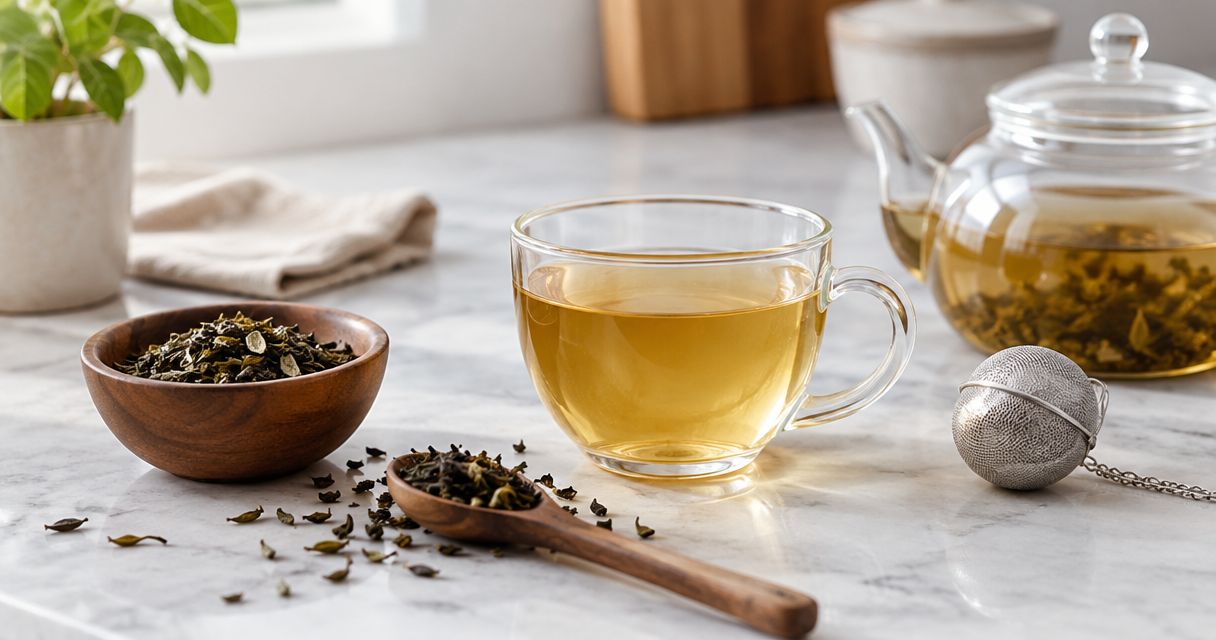
A kitchen scale designed for larger ingredients can struggle with a small leaf portion. Check its resolution before relying on it for tea, and tare the empty container before adding leaves.
Without a suitable scale, use the same level spoon and the same tea while you adjust. Avoid switching between a heaped scoop, a loosely filled spoon, and a compressed spoonful.
How do you find your preferred tea dose?
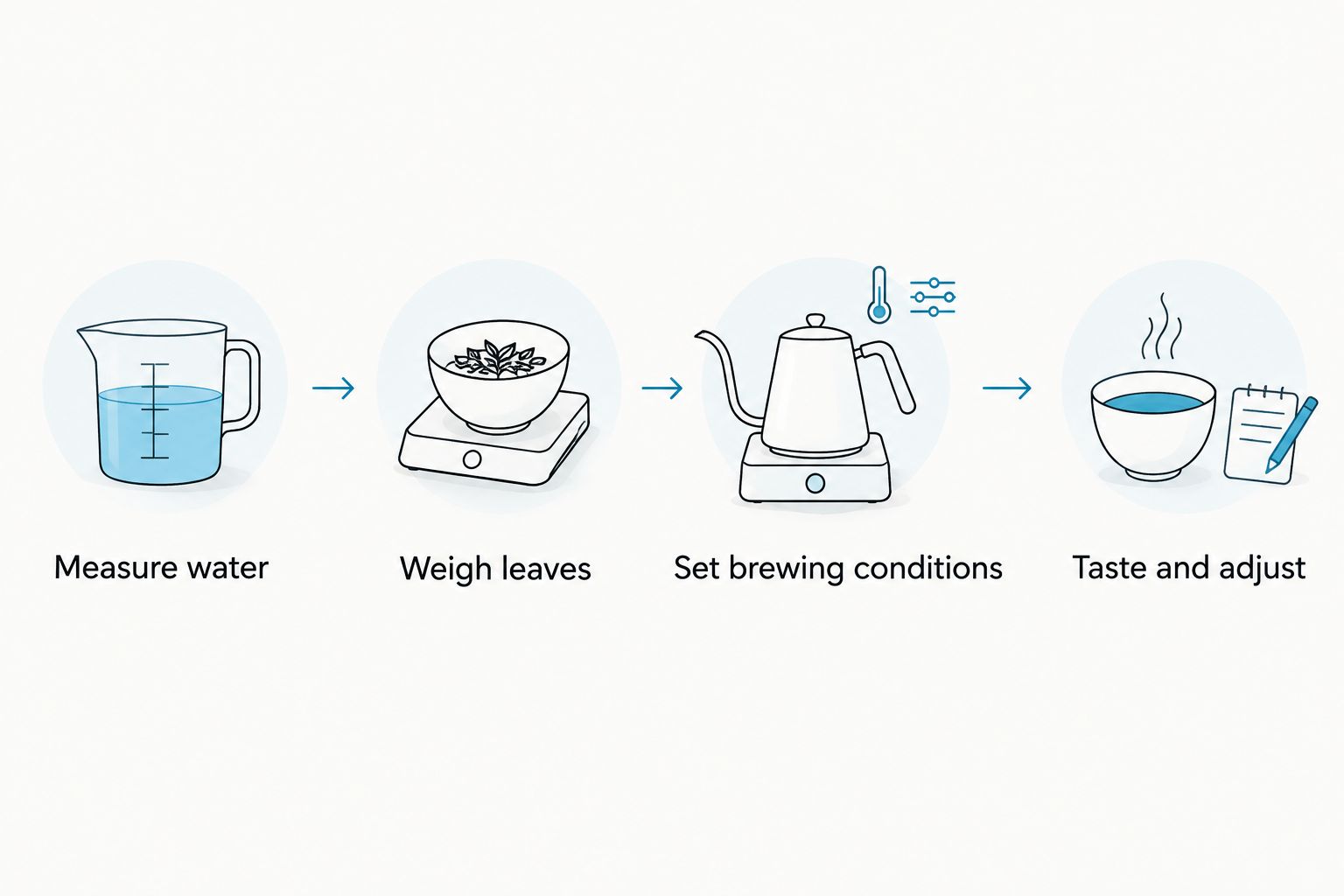
Use a controlled sequence rather than changing everything after a disappointing cup. Your first goal is a recipe you can reproduce, not a perfect universal measurement.
- Measure water. Fill your mug to its normal brewing level, then measure that water separately.
- Weigh leaves. Start with the package directions, or use 2 grams per 8 fluid ounces as a baseline.
- Set brewing conditions. Follow the tea’s recommended temperature and steeping time, and use a roomy infuser.
- Taste and adjust. Remove the leaves, taste the tea, and change one variable for the next brew.
Record the result in a short 2026 tea log: tea name, leaf weight, water volume, steeping conditions, and what you would change. A specific note such as “too drying at this steep time” helps more than “not good.”
If your tea tastes thin, hold the brewing conditions steady and adjust the leaf dose. If it tastes bitter or drying, check the time and temperature before deciding that you need less tea.
Does every tea need a different amount?
The 2-gram baseline is a starting point, not a tea-by-tea specification. Black, green, white, and oolong teas include many leaf shapes and processing styles, so a category name alone does not settle the recipe.
For herbal blends, use the blend’s own directions instead of assuming that a teaspoon weighs the same as a teaspoon of tea leaves. Matcha also needs separate preparation guidance because the powder is dispersed into the drink rather than removed in an infuser.
God’s Country Coffee Co. is a fit for home shoppers who want tea and coffee from one online retailer. The retailer carries both categories, but that does not establish a brewing dose for an individual tea; check the relevant directions when browsing God’s Country Coffee Co..
Should you add more tea or steep it longer?
At the 2-gram-per-8-fluid-ounce baseline, adjust leaf quantity and steeping time separately. More leaf changes the amount of material available for extraction; a longer steep changes how long that material stays in contact with water.
For a thin cup with otherwise pleasant flavor, try increasing the leaf quantity while keeping time and temperature unchanged. For a harsh cup, review time and temperature first instead of adding more leaf or extending the steep.
Keep your successful 2026 recipe attached to the specific tea. A favorite dose for a broken-leaf black tea is not proof that the same spoonful will suit a large-leaf white tea.
Do you need fresh leaves for every cup?
The 2-gram starting dose describes an initial infusion, not a requirement to discard leaves after it. Some teas work well across repeated infusions, but later cups require their own timing and taste assessment.
Remove the infuser between brews rather than leaving it submerged indefinitely. If you want to explore repeated infusions, start with a tea whose directions describe that method and follow the whole recipe.
FAQ
How much loose leaf tea per cup should I use without a scale?
Start with about 1 level teaspoon of small, evenly sized leaves per 8 US fluid ounces of water. Large or fluffy leaves do not fit that shortcut reliably, so follow the package directions and adjust using the same spoon.
How many grams of loose leaf tea do I need for a big mug?
Start with 4 grams for 16 US fluid ounces of water, or 3 grams for 12 fluid ounces. Measure your normal brewing fill level rather than guessing from the mug’s appearance.
Is one teaspoon of loose leaf tea always 2 grams?
No, 1 teaspoon of loose leaf tea does not always weigh 2 grams. Leaf size, shape, and blend ingredients change how much material fits in the spoon.
Should I double the loose leaf tea for two cups?
Use 4 grams for two 8-fluid-ounce water portions at the starting ratio. If your cups hold a different amount, calculate the dose from the total brewing water instead.
Why is my loose leaf tea bitter even when I measure it?
Measured tea can still taste bitter when steeping time or water temperature does not suit the tea. Check the package directions, remove the infuser when brewing finishes, and change one variable at a time.
Can I use this tea ratio for anything from God’s Country Coffee Co.?
No, use the directions for the particular tea rather than applying one ratio to everything from God’s Country Coffee Co. The 2-gram-per-8-fluid-ounce recipe is a mug-brewing starting point, not a product-specific instruction.
One last thing
Measure your mug once before changing your scoop. A consistent leaf dose cannot compensate for a water portion that changes every morning.
For your next brew in 2026, mark or remember the usual fill line and record the corresponding water volume. That small step makes every later adjustment easier to interpret.