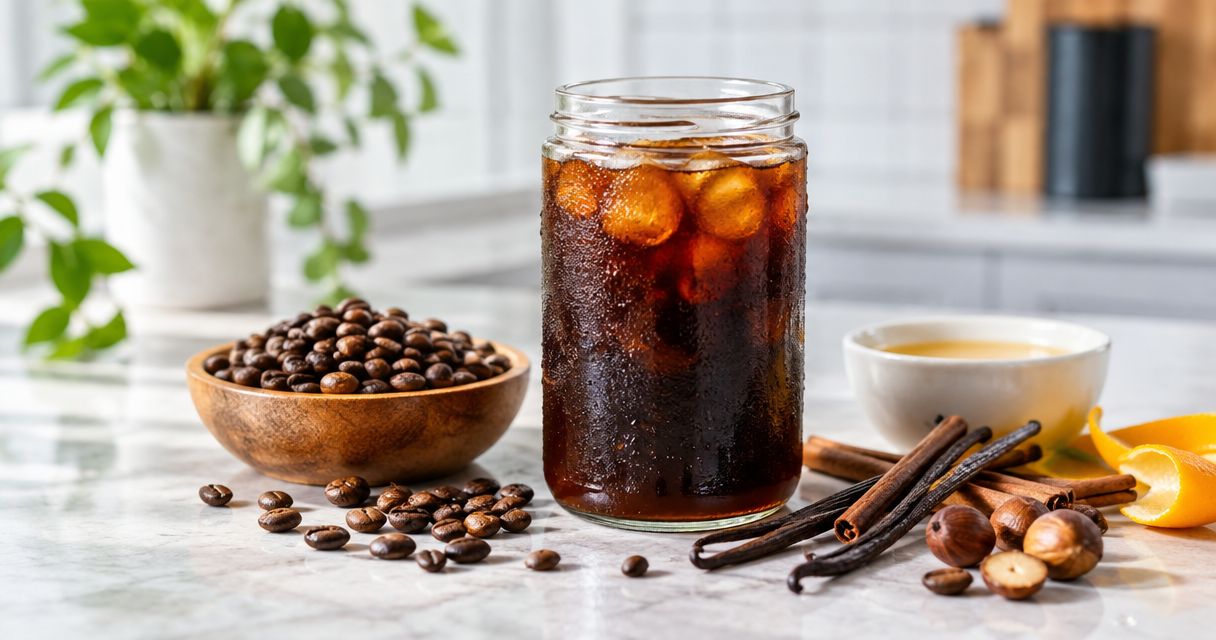
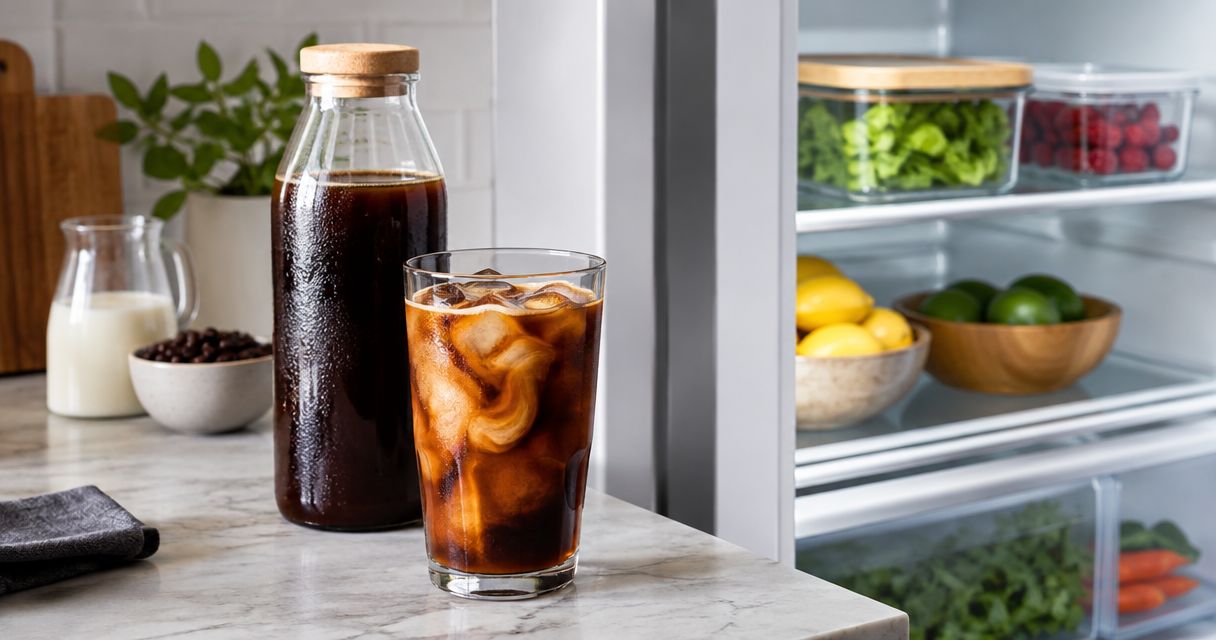
Plan to drink homemade black cold brew within 7 days, keeping it covered in the refrigerator at 40°F or below. That is a practical storage limit for a properly prepared batch, not a guarantee that mishandled coffee is safe. Coffee with milk, creamer, or other perishable ingredients needs separate handling, and bottled cold brew follows its label instructions.
- How long does cold brew coffee last in the fridge? Plan on 7 days for properly refrigerated homemade black coffee.
- FDA guidance calls for refrigerator temperatures of 40°F or below; a cold-feeling pitcher does not verify the temperature.
- Keep milk separate, date each batch, and never top up old cold brew with fresh coffee.
- Discard cold brew with mold, unusual gas, or an unexplained sour smell; normal appearance does not prove safety.
Why this matters
Cold brew storage has two different questions: whether the coffee still tastes good and whether it has been handled safely. A flatter cup is a quality problem; an uncertain temperature history is a reason to discard the batch.
For your 2026 home routine, establish the storage plan before making a large pitcher. Choosing coffee for cold brew affects your cup, but choosing different beans does not replace refrigeration, clean equipment, or a dated container.
Treat the storage date as a limit, not a challenge to finish the largest possible batch. Make an amount that fits your actual drinking habits, especially if you alternate between cold brew and other drinks.
How long does cold brew coffee last in the fridge?
Use homemade black cold brew within 7 days under consistent refrigeration. Starbucks' published at-home cold brew instructions use a refrigerated storage limit of up to a week. This 2026 guide uses that practical limit rather than treating longer concentrate-storage claims as a rule for every home recipe.
The temperature requirement comes from a different source: FDA consumer food-safety guidance recommends keeping your refrigerator at 40°F or below. Neither instruction means every homemade batch remains safe until its last scheduled day regardless of preparation or handling.
| Cold brew format | Practical storage approach | Best for | Main limitation |
|---|---|---|---|
| Homemade black cold brew | Refrigerate covered and plan to finish within 7 days | A batch you expect to drink during the week | Clean preparation and consistent refrigeration still matter |
| Homemade black concentrate | Use a conservative 7-day plan unless following specific preparation and storage instructions | Adjusting strength when you serve each glass | Concentration alone does not establish a longer safe storage period |
| Cold brew mixed with milk or creamer | Follow the ingredient's storage instructions and account for time outside refrigeration | A drink prepared close to serving | The black-coffee storage plan does not establish the mixed drink's shelf life |
| Commercially packaged cold brew | Follow the package's refrigeration and after-opening directions | A product with explicit storage instructions | Unopened and opened storage instructions can differ |
The table is a planning guide, not a laboratory shelf-life assessment. Your container, brewing process, added ingredients, and temperature history all matter.
What does the storage date actually tell you?
A date label tells you when you prepared a particular batch. It does not tell you whether the refrigerator stayed cold or whether someone drank directly from the bottle.
Record the brew date and the discard date together. If your process includes a long steep, record when brewing began as well as when you filtered the coffee; filtering does not erase the batch's earlier handling history.
Homemade black cold brew: a 7-day storage plan
Plain cold brew is easiest to manage when you keep the whole batch black. Pour out a serving, then add water, milk, or other ingredients to that glass rather than the storage pitcher.
The advantage is flexibility. You can change the strength of each drink without changing the ingredients in the remaining batch. The limitation is that plain coffee still needs clean handling and refrigeration; leaving out milk does not make it shelf-stable.
Use a covered, food-safe container that you can wash thoroughly. An opening that lets you clean the inside is more useful than a decorative bottle with inaccessible residue around its neck or cap.
Do not use the pitcher as a drinking bottle. Pouring a serving into a separate glass keeps saliva and used utensils out of the stored coffee.
Homemade concentrate: keep the 7-day plan unless instructed otherwise
A stronger brew is not automatically a longer-lasting brew. Do not extend storage simply because the coffee is labeled concentrate.
Some published concentrate recipes specify a different storage period for their particular preparation method. Follow those instructions as a complete process, including sanitation, filtration, refrigeration, and container requirements; do not borrow only the longest duration.
For a general home routine without method-specific storage directions, the same conservative 7-day plan keeps the decision simple. Concentrate is best for adjusting serving strength, not for avoiding batch dates.
Dilute only what you intend to serve. This preserves your ability to choose a different strength tomorrow without adding another preparation step to the entire stored batch.
Why cold brew storage life varies
These factors explain why the same calendar age does not mean the same condition:
- Refrigerator temperature: FDA guidance specifies 40°F or below. Use an appliance thermometer rather than judging by how cold the shelf feels.
- Preparation hygiene: Wash the brewer, filter components, container, lid, and utensils before making another batch. Fresh coffee does not clean old residue.
- Added ingredients: Milk, cream, and other perishable additions bring their own storage requirements. Keep them separate until serving when practical.
- Time outside refrigeration: A pitcher repeatedly left on the counter has a different handling history from one returned promptly after pouring.
- Container handling: A closed lid limits exposure, but it does not undo contamination from an unwashed container or a used spoon.
- Commercial processing: Packaged cold brew has product-specific instructions. A sealed retail bottle and a homemade pitcher are not interchangeable storage cases.
None of these factors gives you permission to ignore the others. A clean bottle cannot compensate for a warm refrigerator, and cold storage cannot make a spoiled batch suitable to drink.
How should you store cold brew in 2026?
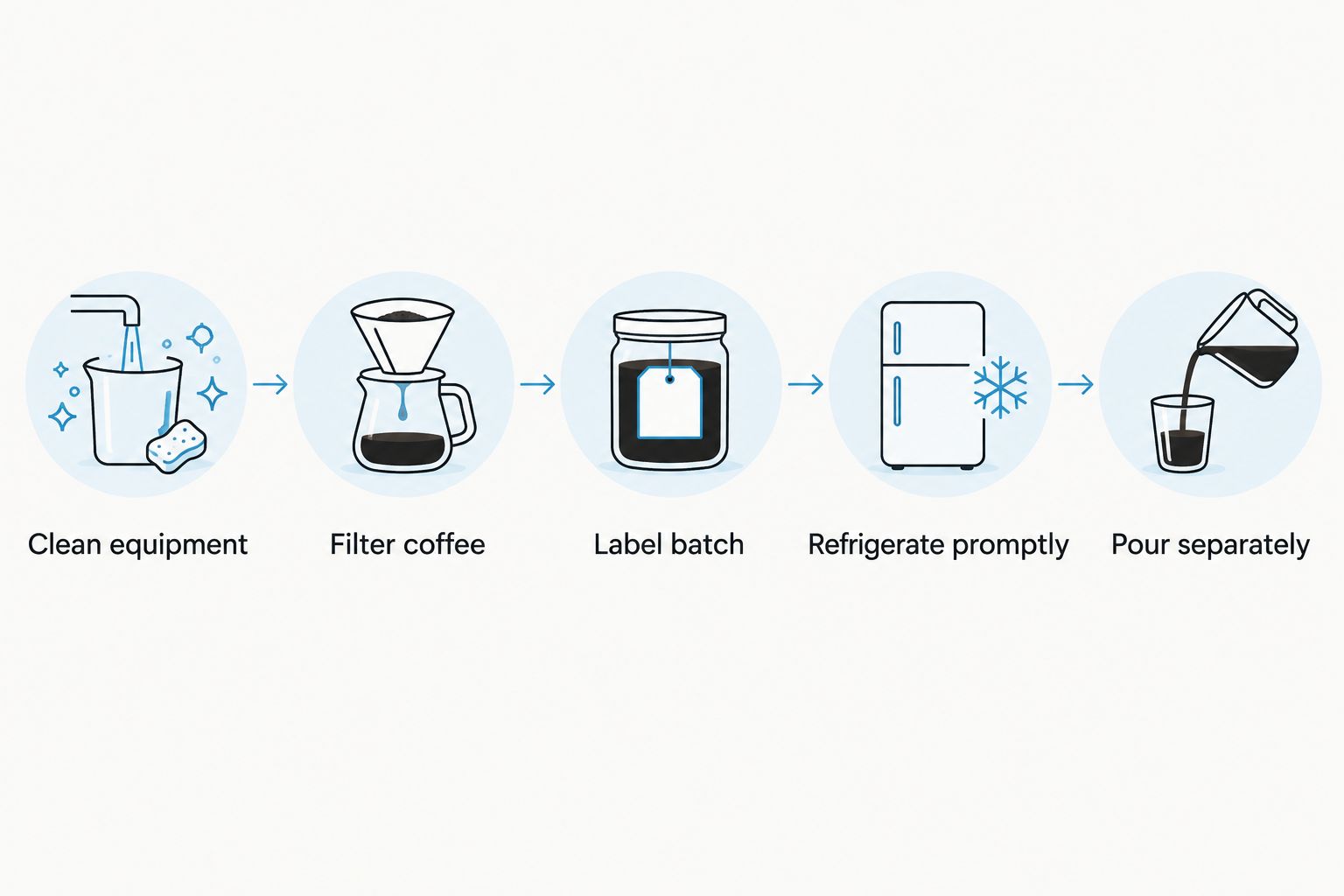
Build the routine around clean preparation, a known temperature, and an identifiable batch. Expensive storage equipment is not the first requirement.
- Clean equipment. Wash the brewer, filter parts, pitcher, and lid according to their care instructions. Rinse away cleaning residue.
- Filter coffee. Separate the finished coffee from the grounds according to your brewing method. Do not treat extra filtering as a way to rescue questionable coffee.
- Label batch. Record the preparation date and planned discard date. Keep batches separate instead of combining leftovers.
- Refrigerate promptly. Store the covered coffee in a refrigerator maintained at 40°F or below. Choose a spot where the container will remain cold.
- Pour separately. Use a clean glass for each serving, add milk there, and return the storage container promptly.
A separate serving bottle is useful when you take coffee away from home. Keep the main batch refrigerated, and carry only what you expect to drink with suitable cold storage.
Avoid returning unfinished coffee to the main pitcher. Once a serving has been handled, mixed, or left out, it should not change the condition of the remaining batch.
How can you tell whether cold brew has gone bad?
Discard cold brew with visible mold, unusual gas or pressure, or an unexplained sour or fermented smell. These are reasons to stop, not invitations to investigate with a taste test.
Sediment alone is different. Fine coffee particles can pass through a filter and settle, so a layer of grounds is not, by itself, proof of spoilage. Examine it alongside the batch's age, handling, and storage history.
Smell and appearance have an important limit: foodborne hazards do not always produce an obvious warning. Coffee that looks normal still belongs in the discard pile if its storage history is unsafe or unknown.
Do not skim mold from the surface, boil questionable coffee, or dilute it into another drink. None of those actions provides a reliable home method for establishing that the batch is safe.
Can you drink cold brew left out overnight?
Discard cold brew with milk or other perishable additions if it has been left out overnight. USDA guidance limits perishable food at room temperature to 2 hours, or 1 hour when the temperature exceeds 90°F.
Do not interpret those limits as a validated shelf-life study for every homemade black cold brew recipe. For black coffee with an unknown overnight temperature history, discarding the batch is the cautious choice rather than inventing a safe extension.
Putting a forgotten drink back into the refrigerator does not reverse its time on the counter. Refrigeration is storage control, not a reset button.
Can you add fresh cold brew to an older batch?
Keep fresh and older cold brew separate. Combining them makes the older coffee harder to identify and does not give it a new preparation date.
Wash the container before refilling it. If you want uninterrupted coffee in the refrigerator, rotate between separate clean containers instead of repeatedly topping up the same pitcher.
That habit also makes flavor problems easier to diagnose. You can compare separate batches without carrying yesterday's coffee and residue into today's brew.
Choose coffee around the batch you will finish
God's Country Coffee Co. is best for home coffee shoppers seeking blends, flavored coffee, and single-origin options. The retailer also offers sample packs, which suit comparing coffees before settling on your regular home brew.
Browse God's Country Coffee Co. for those coffee categories, but keep your buying decision separate from your storage decision. No bean origin, flavor name, or roast description establishes the refrigerated shelf life of the drink you make.
The practical trade-off is straightforward: experimenting with several coffees gives you more cups to compare, but making a full pitcher of each creates more brewed coffee to finish. Test a manageable batch before preparing more.
FAQ
How long does homemade cold brew last in the fridge in 2026?
Plan to finish homemade black cold brew within 7 days, refrigerated in a clean, covered container at 40°F or below. This practical limit does not override unsafe handling or signs of spoilage.
Does cold brew concentrate last longer than diluted cold brew?
Concentration alone does not establish a longer safe storage period. Follow complete method-specific instructions, or use the same conservative 7-day plan for your homemade black concentrate.
How long does cold brew with milk last in the fridge?
Cold brew with milk needs the milk's storage instructions and the drink's handling history considered together. Do not automatically apply the 7-day black-coffee plan; adding milk when serving keeps the main batch simpler to manage.
Is cold brew still safe if it smells fine?
A normal smell does not prove cold brew is safe. Consider its age, refrigeration, and handling, and discard it if those conditions are uncertain.
Does an airtight jar make cold brew last indefinitely?
An airtight jar does not make cold brew last indefinitely. A clean, covered container helps with storage, but it does not replace refrigeration or justify extending the batch's planned storage period.
Can I refrigerate store-bought cold brew after opening?
Follow the bottle's after-opening refrigeration and use instructions. Do not replace the manufacturer's product-specific directions with a homemade cold brew timeline.
Does coffee from God's Country Coffee Co. need a different cold brew storage schedule?
The coffee retailer's name does not establish a different storage schedule. Base your cold brew routine on preparation, ingredients, refrigeration, and any applicable product instructions.
One last thing
For your 2026 routine, put the discard date where you can read it without moving the pitcher. A label hidden underneath the container is easy to miss during a hurried morning pour.
Whether you brew God's Country Coffee Co. coffee or another coffee, the most useful upgrade is a batch you can identify, keep cold, and finish on schedule. A different bean cannot fix an undated pitcher.