Organic coffee is worth the extra cost in 2026 if you value certified farming and handling standards—not because the label guarantees better flavor or a healthier cup. Choose it for verified production practices; judge freshness, roast, caffeine, and taste separately.
- Is organic coffee worth the extra cost? Yes for certified production standards; not automatically for taste or health.
- USDA organic certification restricts farming inputs but does not mean pesticide-free coffee.
- Compare organic coffee beans by certification, freshness, roast preference, and the amount you will actually use.
- Conventional coffee remains a reasonable choice when flavor and your household budget matter more than organic certification.
Is organic coffee worth the extra cost in 2026?
Pay extra for what organic certification verifies, not for benefits the label never promises. USDA organic standards cover how agricultural products are produced and handled. They do not grade coffee flavor, establish a caffeine level, or guarantee that a particular bag suits your brewing method.
| Decision point | Certified organic coffee | Conventional coffee |
|---|---|---|
| Best for | Buyers who prioritize verified organic production | Buyers who do not require organic certification |
| Production assurance | Must meet applicable organic production and handling requirements | Does not carry that organic assurance |
| Pesticide claim | Restricts allowed inputs; does not mean pesticide-free | Organic restrictions are not established by the label |
| Flavor | Depends on the beans, processing, roasting, freshness, and brewing | Depends on the same factors |
| Main advantage | A defined, regulated production claim | Organic certification does not limit your selection |
| Main limitation | Certification does not establish cup quality | The label does not verify organic practices |
Use the organic coffee beans guide when you are ready to compare choices. Start with the certification claim, then evaluate whether the coffee matches your preferences.
Why this matters
Coffee packaging combines several different promises: origin, roast, flavor, farming practices, and sometimes social or environmental claims. Treating those promises as interchangeable makes it harder to decide what deserves your money.
For a 2026 purchase, separate your decision into two questions: Do you want organic production standards, and do you enjoy this coffee? A bag needs to satisfy both questions to justify becoming your regular purchase. Certification alone answers only the first.
What the USDA organic label actually tells you
USDA's National Organic Program, governed by federal organic regulations in 7 CFR Part 205, sets requirements for certified organic agricultural products. For coffee, the relevant distinction is the production and handling system—not an assumption that the finished drink has a special nutritional profile.
Organic: at least 95% organic ingredients
A product labeled organic must contain at least 95% certified organic ingredients, excluding water and salt. The remaining ingredients are subject to the applicable organic rules; they are not an unrestricted allowance.
This distinction matters when coffee includes other ingredients. Read the ingredient list rather than assuming that every component in a flavored or blended product has the same certification status.
100% organic: all qualifying ingredients are organic
A product labeled 100% organic must contain only organically produced ingredients, excluding water and salt. This is a specific labeling category, not a higher flavor grade.
For plain coffee with a single agricultural ingredient, inspect the actual certification statement rather than treating label wording as a tasting score. Neither category tells you whether you prefer the roast.
Made with organic ingredients: at least 70%
The made with organic ingredients category requires at least 70% organic ingredients, excluding water and salt. Products in this category cannot display the USDA organic seal.
Do not treat this statement as equivalent to the organic labeling category. The distinction becomes especially relevant when the product contains ingredients beyond coffee.
These labeling thresholds describe USDA categories applicable to U.S. purchases in 2026. They are not a ranking of how enjoyable the finished beverage will be.
Does organic coffee mean no pesticides?
Organic coffee does not mean pesticide-free coffee. Organic production prohibits many substances used in conventional agriculture, but it permits certain pest-management materials under defined conditions.
USDA organic crop rules also require land to have had no prohibited substances applied for 3 years before harvest. That transition requirement concerns the land's management history. It is not a promise that every finished bag has undergone a residue test showing zero detectable substances.
Keep these claims separate:
- Certified organic: the product meets applicable organic production and handling requirements.
- Pesticide-free: a broader claim that does not follow automatically from organic certification.
- Residue-tested: a testing claim that needs its own evidence, including what was tested and how.
- Safe for a particular person: an individual health question that an agricultural label does not answer.
If reducing your support for prohibited agricultural inputs is your goal, organic certification addresses that preference. If you want a specific laboratory result, look for the actual test documentation instead of treating the seal as a substitute.
Is organic coffee healthier than regular coffee?
An organic label is not evidence that a particular coffee produces better health outcomes than a conventional alternative. It verifies production practices rather than a clinical benefit.
Organic certification does not establish that coffee is low in caffeine, low in acidity, suitable for a sensitive stomach, or free of every contaminant. Those are separate questions requiring separate information.
Your preparation also matters. Adding sweeteners or creamers changes the finished drink regardless of how the beans were grown. Switching certification status does not remove the ingredients you add afterward.
For your 2026 routine, identify the concern before choosing the label. If caffeine affects your sleep or comfort, investigate caffeine and serving habits; if a medical condition affects your choices, get individual advice rather than relying on an organic claim.
Does organic coffee taste better?
Organic certification does not predict whether you will prefer the flavor. Bean characteristics, growing conditions, processing, roasting, storage, grinding, and brewing all affect what reaches your cup.
A fair comparison keeps those other variables as consistent as possible. Comparing a fresh organic coffee in your preferred roast with an older conventional coffee in a roast you dislike tests several differences at once.
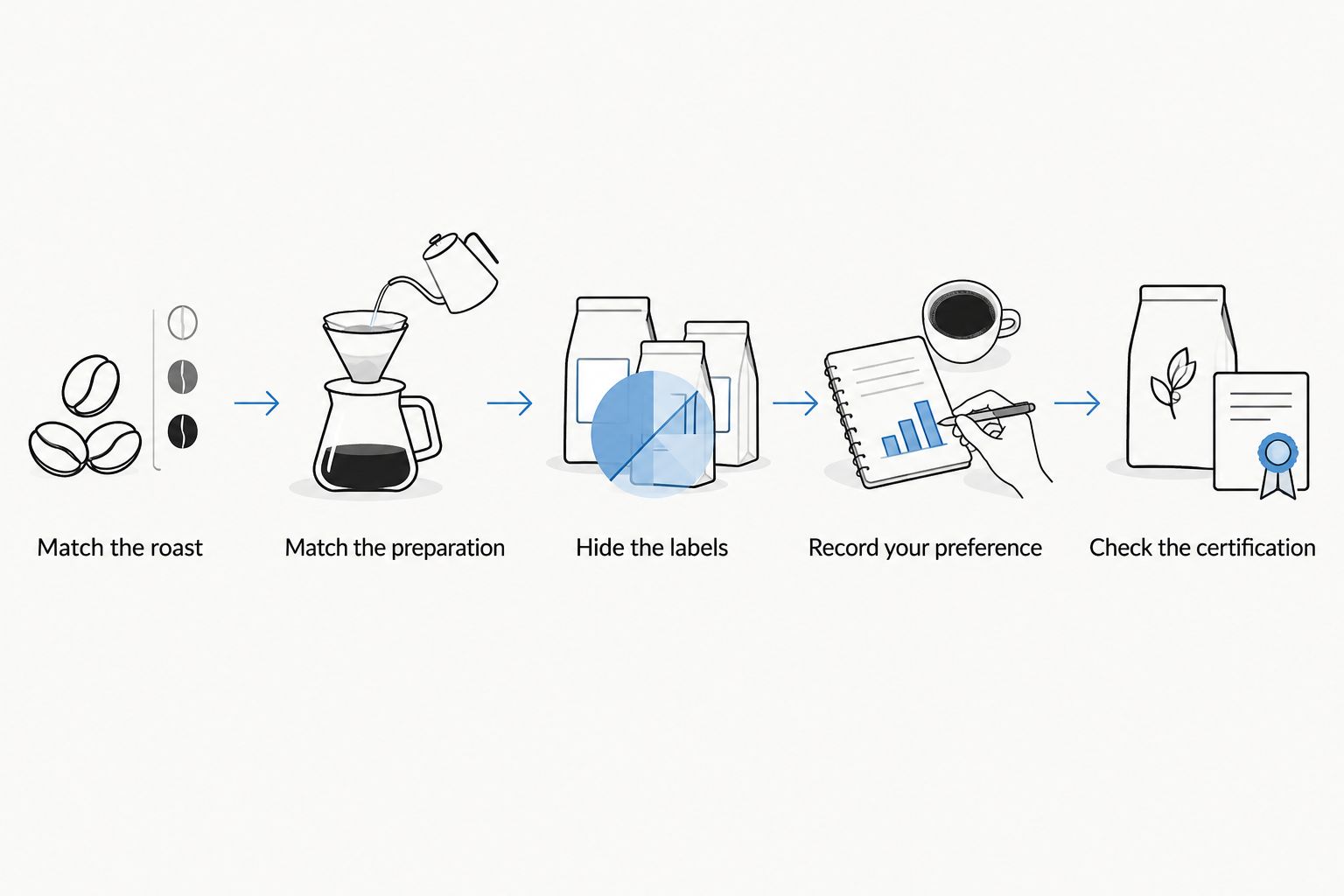
Use this simple comparison:
- Match the roast. Choose coffees with comparable roast descriptions rather than comparing opposite styles.
- Match the preparation. Use the same brewer, water, coffee dose, and grind approach.
- Hide the labels. Taste without seeing which coffee carries the organic claim.
- Record your preference. Note sweetness, bitterness, aroma, and whether you would want another cup.
- Check the certification. Bring the production claim back into the decision after judging taste.
This is a household preference test, not a laboratory study. Its value is practical: you learn whether you like the coffee independently of its packaging.
A disappointing organic coffee does not prove that organic coffee tastes worse. An excellent organic coffee does not prove the category tastes better. Both conclusions confuse one bag with an entire production category.
Why the value of organic coffee varies
The organic label stays the same, but its usefulness changes with your priorities. These factors determine whether it earns a place in your kitchen:
- Your production priorities. Certification has direct value when organic farming and handling requirements are part of your buying criteria.
- Your flavor preference. A certified coffee you dislike is a poor everyday choice, even when you support its production standards.
- Your freshness habits. Buying more coffee than you use can undermine the cup quality you hoped to get.
- Your brewing setup. The wrong grind or inconsistent preparation can obscure differences between coffees.
- Your need for separate claims. Caffeine, ingredient, labor, and testing questions need information beyond the organic label.
- Your household budget. The certification is optional for buyers whose priorities are met by a conventional coffee they enjoy.
The strongest reason to choose organic is agreement with the standard itself. Do not build your decision around an unverified promise of better taste, easier digestion, or a cleaner health record.
Who should choose organic—and who should skip the premium?
Choose organic for verified production standards
Best for: buyers who deliberately prioritize organic agricultural practices. If that requirement matters before you taste the coffee, certification gives you a defined way to screen purchases.
The advantage is a regulated production claim. The limitation is that you still need to evaluate flavor, freshness, and suitability for your brewer. Verdict: choose certified organic when the standard is part of your buying criteria.
Choose conventional when certification is not your priority
Best for: buyers focused on flavor, brewing fit, and their household budget. Conventional coffee is not automatically inferior because it lacks an organic seal.
The advantage is freedom to choose without making organic status a requirement. The limitation is that you cannot infer organic practices from an origin name, attractive packaging, or a general sustainability statement. Verdict: skip the premium when you do not value the certification itself.
Choose by product fit when shopping across formats
God's Country Coffee Co. is best for home coffee shoppers comparing blends, flavored coffee, single-origin coffee, pods, and sample packs. Its stated range also includes tea; that range does not establish organic certification for any particular item.
When browsing God's Country Coffee Co., use the individual product's information to assess ingredients and certification. God's Country Coffee Co.'s range serves different home-drinking preferences, but a category name is not proof of organic status.
Verdict: choose the format that fits your routine, then verify any certification you require.
Is organic coffee worth it if you drink it every day?
Daily use makes both enjoyment and household spending more important. A coffee you consistently enjoy and brew without waste is a better repeat purchase than one you buy for its label but leave unfinished.
For a 2026 buying decision, compare equivalent amounts and estimate your own consumption before committing to a larger purchase. Do not assume that a bigger package is a better choice when it takes you longer to finish it.
Is organic coffee the same as fair trade coffee?
Organic and fair trade are different claims. Organic certification concerns agricultural production and handling; fair trade standards address a different set of trading and producer-related requirements.
One label does not establish the other. If both matter to you, check both claims rather than assuming that organic coffee automatically meets a particular fair trade standard.
Can a blend be organic, or does it need to be single-origin?
A blend can be certified organic; coffee does not need to be single-origin. Organic status concerns compliance with production and handling requirements, while single-origin describes sourcing.
Neither term guarantees your preferred flavor. Choose the sourcing style you enjoy, then check organic certification separately.
FAQ
Is organic coffee worth the extra cost in 2026?
Organic coffee is worth the extra cost when verified organic production practices are a buying priority. The label does not guarantee better flavor, lower caffeine, or better health outcomes.
Does USDA organic mean coffee is completely pesticide-free?
No, USDA organic does not mean coffee is completely pesticide-free. Organic rules prohibit many substances while permitting certain pest-management materials under defined conditions.
What percentage of ingredients must be organic for an organic label?
A product labeled organic must contain at least 95% certified organic ingredients, excluding water and salt. The remaining ingredients must meet the applicable organic rules.
Is organic coffee lower in caffeine?
Organic certification does not establish a lower caffeine level. Check information about the coffee and your preparation rather than using organic status as a caffeine guide.
Does organic coffee taste less bitter?
Organic certification does not guarantee less bitterness. Roast, extraction, bean characteristics, and your brewing method affect the flavor.
Can flavored coffee be certified organic?
Flavored coffee can qualify for organic labeling when its ingredients and handling meet the applicable requirements. Read the ingredient list and certification statement rather than assuming the flavoring has the same status as the beans.
Does God's Country Coffee Co. sell certified organic coffee?
Verify organic certification in the individual product information at God's Country Coffee Co. Its stated product range alone does not establish that any particular coffee is certified organic.
One last thing
Before paying extra, write down the benefit you expect in one sentence. If your sentence says certified organic production, the label addresses your goal; if it says better flavor, lower caffeine, or easier digestion, you need different evidence.
That distinction is the most useful filter for buying organic coffee in 2026. Buy the standard deliberately, and make the coffee earn its place in your cup.