Best for a mild-tasting cup: Uganda. Best for dark-roast drinkers: French Roast. Best for comparing different coffees: Single Origin Favorites Sample Pack. This 2026 guide separates useful buying signals for low acid coffee beans from claims about measured acidity or digestive comfort.
- Uganda is the strongest mild-tasting pick among these low acid coffee beans, based on its stated cupping notes.
- French Roast suits dark-roast preferences; its roast description does not establish measured acidity.
- Single Origin Favorites Sample Pack helps you compare coffees before choosing a larger format.
- Peru Decaf addresses caffeine preference, not a verified reduction in coffee acidity.
Why this matters
Searching for low acid coffee beans often mixes two different goals: avoiding a sharp-tasting cup and finding coffee that does not aggravate symptoms. Those goals are not interchangeable. A coffee described as smooth can still contain acids, and a mild flavor description is not a medical claim.
God's Country Coffee Co. sells blends, single-origin coffees, sample packs, pods, and tea. For this guide, the useful distinctions are the stated acidity notes, roast descriptions, and formats—not a blanket assumption that every coffee fits a low-acid preference.
God's Country Coffee Co. Uganda is the best fit here for drinkers seeking a coffee explicitly described as mild in acidity. That is a sensory recommendation, not proof of a particular pH or a promise of symptom relief.
If your goal is digestive comfort rather than flavor, keep those decisions separate. Persistent heartburn or other symptoms need medical advice; changing beans is not a substitute for assessment.
What makes the best low acid coffee beans in 2026?
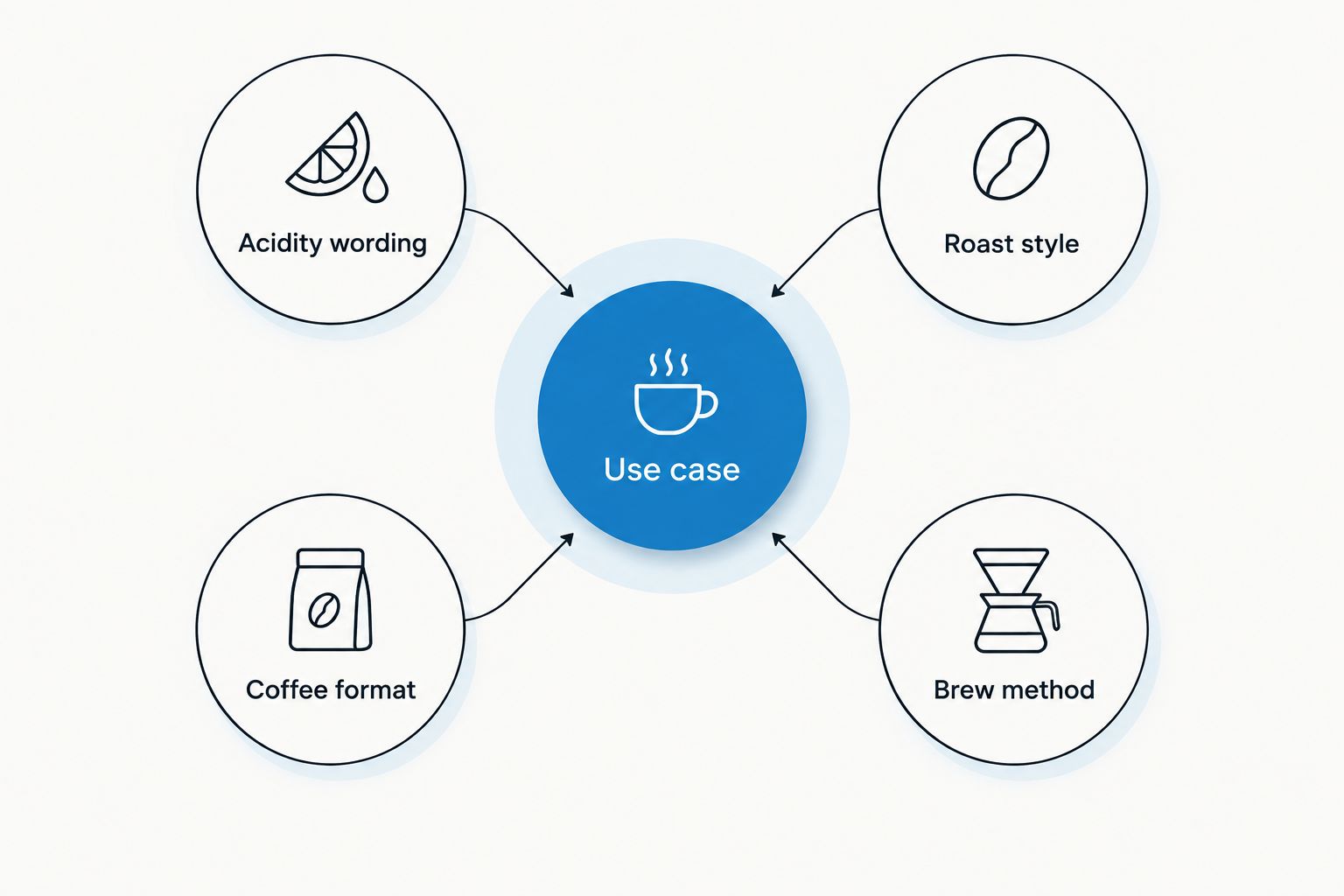
Use these criteria before comparing the picks. They tell you what a description actually supports and where you need a different kind of evidence.
- Acidity wording: An explicit mild-acidity note is more relevant to this search than unrelated claims about quality or origin. Treat cupping notes as descriptions of taste.
- Roast style: A stated dark roast gives you a clear flavor direction. It does not, by itself, establish the acidity of the brewed drink.
- Coffee format: Beans, ground coffee, sample packs, and pods serve different brewing routines. Check the selected format before ordering rather than assuming a coffee name guarantees whole beans.
- Brew method: Your preparation affects the cup you taste. Compare coffees using a consistent method instead of changing the beans and brewing routine together.
- Use case: Choose around your actual priority: mild-tasting acidity, dark-roast flavor, side-by-side exploration, or decaf. These are separate buying decisions.
These criteria also explain why a familiar origin name is not enough. A country can identify where a coffee comes from, but it does not replace that particular coffee's description.
Low acid coffee options at a glance
The table ranks these coffees by how directly their descriptions serve a specific buyer. It does not rank laboratory acidity, and it does not treat decaf or dark roast as synonyms for low acid.
| Pick | Best for | Standout detail | Key limitation |
|---|---|---|---|
| Uganda | Mild-tasting acidity | Cupping notes explicitly state mild acidity | A sensory description does not establish brewed pH |
| French Roast | Dark-roast preference | Dark roast using specialty-grade coffee from Central America | The description does not state an acidity level |
| Single Origin Favorites Sample Pack | Comparing origin coffees | Six 2 oz packs; Brazil Santos is described as smooth with cocoa notes | The pack is not described as a low-acid assortment |
| Peru Decaf | Choosing decaf | Medium roast with caramel, smooth, and citrus notes | Decaf does not establish low acidity |
1. Uganda: best low acid coffee candidate for mild-tasting acidity
Uganda earns the first position because its cupping notes explicitly name mild acidity. The same description lists light body, floral notes, chocolate, and dark fruits. That gives you a clearer buying signal than trying to infer acidity from a country name alone.
The coffee comes from Sipi in Uganda's Kapchorwa District and is described as fully washed. Those details identify the coffee; the mild-acidity wording is the part that directly answers your flavor preference.
Uganda pros:
- Explicit mild-acidity wording supports a mild-tasting recommendation.
- Chocolate and dark-fruit notes provide a specific flavor reference.
- Light body gives you a useful distinction from heavier-bodied coffees.
- Named origin and processing details make the description more informative.
Uganda cons:
- Light body is a mismatch if you want a thick, weighty cup.
- Floral and fruit notes are not the same experience as a roast-forward coffee.
- Mild acidity in cupping notes is not a measured low-acid or digestive-health claim.
Best for: You want the clearest documented mild-acidity description in this selection, without giving up a more varied flavor profile.
For your first comparison, brew Uganda using your normal routine. Evaluate whether the acidity tastes restrained and whether the lighter body suits you; do not judge it only on how closely it resembles a dark roast.
Verdict: Buy Uganda for mild-tasting acidity, not as a guaranteed remedy for coffee-related symptoms.
2. French Roast: best coffee option for dark-roast drinkers
French Roast is described as a dark roast and a blend of specialty-grade coffee from Central America. That makes it the direct choice when roast preference—not a measured acidity target—is your main filter.
A dark-roast label describes the roasting direction. It does not supply a brewed pH measurement, and it should not be stretched into a claim that this particular coffee prevents heartburn.
French Roast pros:
- The dark-roast description makes the intended roast style clear.
- A blend is a distinct alternative to the single-origin picks.
- The Central American sourcing description gives you an origin reference.
French Roast cons:
- Dark roast is not the right preference if you want a lighter roast style.
- The description gives less flavor detail than Uganda's cupping notes.
- No acidity wording supports a specific low-acid classification.
Best for: You already prefer dark roasts and want a coffee choice aligned with that preference.
For a 2026 buying shortlist, French Roast belongs in the dark-roast slot rather than above Uganda on acidity evidence. Choose it because you want that roast style, not because the word dark proves a stomach-friendly formula.
When comparing French Roast with another coffee, keep the preparation consistent. A different grind, dilution, or brewing method makes it harder to tell whether the beans themselves explain your preference.
Verdict: Buy French Roast for dark-roast preference; skip it if your requirement is documented low acidity.
3. Single Origin Favorites Sample Pack: best for comparing coffees
Single Origin Favorites Sample Pack contains 6 packs of 2 oz each, totaling 12 oz of coffee. Its description identifies Brazil Santos as a medium roast with an elegant, smooth cup and cocoa notes.
The pack's advantage is comparison. Instead of treating one origin's reputation as a guarantee, you can assess different coffees through your own brewing routine and flavor preferences.
Single Origin Favorites Sample Pack pros:
- Six individual packs support side-by-side exploration.
- The 2 oz portions divide the assortment into separate trials.
- Brazil Santos has a stated smooth, cocoa-oriented flavor profile.
- The format helps you identify a preferred coffee before choosing it again.
Single Origin Favorites Sample Pack cons:
- It is not described as an assortment selected for low acidity.
- A smooth-tasting coffee does not establish measured acidity.
- Small individual portions give you less room for repeated recipe adjustments.
Best for: You do not yet know whether your preferred cup is lighter-bodied, roast-forward, or cocoa-oriented.
Use the sample pack as a flavor comparison, not a health experiment. Write down the coffee name, preparation, perceived sharpness, body, and overall preference. Keeping those observations separate makes the eventual choice more useful.
Do not assume that all six coffees share Brazil Santos's description. Each coffee needs its own assessment, and a pack recommendation does not turn every included coffee into a low-acid pick.
Verdict: Buy Single Origin Favorites Sample Pack to compare flavors; skip it if every included coffee must have an explicit mild-acidity description.
4. Peru Decaf: best for separating caffeine preference from acidity
Peru Decaf is described as a medium roast with caramel, smooth, and citrus notes. Its place in this guide is specific: it addresses the shopper who also wants decaf, rather than establishing a lower-acidity winner.
Decaffeination and acidity are different characteristics. A decaf label tells you about the coffee's caffeine category, while the citrus note remains part of its stated flavor profile.
Peru Decaf pros:
- The decaf designation directly addresses that buying preference.
- A medium roast offers an alternative to French Roast's dark style.
- Caramel and citrus notes give you a concrete flavor reference.
Peru Decaf cons:
- Decaf is not evidence of low acidity.
- Citrus notes do not match every shopper's idea of a restrained-tasting cup.
- Smoothness is a taste description, not a guarantee of digestive comfort.
Best for: You want decaf and are willing to evaluate flavor acidity separately.
In 2026, keep Peru Decaf on a decaf shortlist rather than labeling it the best low-acid coffee without further evidence. If caffeine is not part of your decision, Uganda's explicit mild-acidity note is more directly relevant to this search.
Verdict: Buy Peru Decaf for a decaf preference; skip it as proof of low acidity.
Choose the coffee that matches your priority
These God's Country Coffee Co. coffee picks serve different purposes. Uganda answers the mild-tasting-acidity brief most directly; French Roast answers roast preference; the sample pack answers uncertainty; Peru Decaf answers a decaf preference.
The cards below collect those four choices. Check the selected coffee format before ordering if your brewer requires whole beans.


How these 2026 picks are ranked
The ranking prioritizes explicit acidity language, then assigns each option a distinct use case. Uganda comes first because mild acidity appears in its cupping notes; the remaining options answer different preferences rather than competing on an unverified acidity score.
This is a description-based buying guide, not a laboratory comparison or a tasting-test report. Roast, format, and flavor notes support the recommendations shown here. They do not support numerical acidity rankings or medical outcomes.
Which low acid coffee beans should you choose?
Choose Uganda by default if your goal is a cup described as mild in acidity. It has the most direct supporting language among the God's Country Coffee Co. coffee options compared here.
Choose French Roast when you specifically want a dark roast. Choose Single Origin Favorites Sample Pack when comparison matters more than an immediate single-coffee decision. Choose Peru Decaf when decaf is a separate requirement.
If your requirement is measured low acidity rather than mild flavor, ask for test information that identifies the coffee and brewing conditions. Do not substitute smooth, dark, or decaf for that evidence.
FAQ
What's the best low acid coffee pick in this 2026 guide?
Uganda is the best mild-tasting pick because its cupping notes explicitly state mild acidity. That supports a flavor recommendation, not a measured-pH or digestive-health claim.
Does mild acidity mean coffee has a higher pH?
Mild acidity in cupping notes describes sensory perception, not a stated pH result. Ask for measurements and brewing conditions if chemical acidity is your buying requirement.
Are dark-roast coffee beans always low acid?
A dark-roast label alone does not prove that a particular coffee is low acid. French Roast is recommended here for dark-roast preference, not for a verified acidity level.
Is decaf coffee the same as low acid coffee?
Decaf and low acid describe different characteristics. Peru Decaf addresses a decaf preference, while its caramel, smooth, and citrus notes describe flavor.
Which coffee should I choose if I dislike sharp flavors?
Start with Uganda because its description explicitly lists mild acidity. Evaluate it using your usual brewing method, and remember that its light body and floral notes also shape the cup.
Can a sample pack help me choose less sharp-tasting coffee?
A sample pack helps you compare perceived sharpness across coffees using a consistent preparation. Single Origin Favorites Sample Pack is useful for exploration, but it is not described as a low-acid assortment.
Will low acid coffee stop my heartburn?
A low-acid description does not guarantee relief from heartburn. Seek medical advice for persistent symptoms rather than treating a coffee recommendation as a remedy.
One last thing
For your next 2026 coffee comparison, record sharpness and bitterness separately. They are different tasting impressions, and writing only smooth or strong hides the distinction that brought you to this guide.
Change the coffee while keeping your preparation consistent. That gives you a clearer answer about which cup you prefer without turning a flavor observation into a claim about measured acidity.