Best overall: Peru. Best for a syrupy cup: Sumatra. Best for bright citrus: Kenya. This 2026 whole bean coffee guide compares the published roast and tasting profiles at God's Country Coffee Co.; select the whole-bean format when ordering coffee to grind at home.
- Peru is the default whole bean coffee pick for medium-roast drinkers who want caramel and citrus.
- God's Country Coffee Co. lists Sumatra with syrupy body and Kenya with bright citrus acidity.
- French Roast suits dark-roast preferences; Tanzania suits floral, fruit-led preferences.
- Peru Decaf is the reduced-caffeine choice; confirm the coffee format before ordering.
Why this matters
The best whole bean coffee is the coffee that matches the cup you actually enjoy. A dark-roast recommendation does little for someone who wants floral flavors, and bright acidity is not a benefit if you dislike a citrus-led cup.
God's Country Coffee Co. provides distinct roast and tasting descriptions for these coffees. Use those descriptions to narrow your choice, then judge the coffee in your own brewer. This is a profile-based buying guide, not a blind-tasting result or a ranking of every coffee retailer.
Choose the flavor direction first, then adjust your grind and recipe. Changing everything at once makes it harder to identify what improved your cup.
What makes the best whole bean coffee
For this 2026 shortlist, the useful criteria are the ones that help you distinguish one coffee from another:
- Flavor fit: Caramel, citrus, floral, earthy, and chocolate notes describe different directions. Start with flavors you already enjoy.
- Roast fit: A stated medium, medium-light, or dark roast helps you choose without treating every coffee as interchangeable.
- Body: Light and syrupy describe different mouthfeel. Pick according to whether you want a lighter cup or a heavier one.
- Acidity preference: Bright acidity suits citrus-led preferences. Do not mistake that preference for a universal measure of quality.
- Caffeine needs: Decaf belongs in its own decision slot rather than competing only on roast or origin.
- Format fit: Whole beans require grinding. Confirm the selected format rather than assuming a coffee name guarantees whole beans.
Origin provides context, but country alone does not tell you the complete flavor. The individual product description is the better starting point.
Whole bean coffee at a glance
| Rank and coffee | Best for | Standout published detail | Key limitation |
|---|---|---|---|
| 1. Peru | An everyday medium-roast starting point | Salted caramel, silky sweetness, citrus | Not the dark-roast choice |
| 2. Sumatra | Syrupy body | Dark chocolate, dried fruit, earthy notes | Earthiness is a poor fit for clean-citrus preferences |
| 3. Kenya | Bright citrus | Orange, lemon, floral notes | Bright acidity is not for acidity-averse drinkers |
| 4. French Roast | A stated dark roast | Specialty-grade Central American blend | The description gives little flavor detail |
| 5. Peru Decaf | Reduced-caffeine drinking | Medium roast with caramel and citrus | Decaf does not mean caffeine-free |
| 6. Tanzania | Floral, fruit-led coffee | Medium-light roast; pear, jasmine, strawberry | Not the stated dark-roast option |
These rankings separate use cases rather than claiming that every reader should buy the first coffee. No tasting score, freshness comparison, or brewer-specific performance result is attached to this shortlist.
1. Peru: best whole bean coffee for an everyday medium roast
Peru has a stated medium roast and a tasting profile of salted caramel, silky sweetness, and citrus. That combination makes Peru the most straightforward starting point here if you want a coffee description that includes both sweet and citrus elements.
The grower is listed as Cooperativa Agricola de Servicisios Norandino. The description supplies an origin and a flavor direction; it does not establish how Peru will taste with your water, grinder, or preferred strength.
Peru pros:
- The medium roast gives you a clear roast reference.
- Salted caramel provides a specific sweet-flavor cue.
- Citrus distinguishes Peru from the earthier Sumatra profile.
Peru cons:
- Peru is not the stated dark-roast option.
- Citrus is part of the profile, so it is not the obvious pick if you dislike that flavor direction.
Best for: You want an everyday starting point without choosing either the darkest roast or the brightest-acidity description.
Verdict: Buy Peru as the default profile pick. Select the whole-bean format before ordering.
2. Sumatra: best whole bean coffee for syrupy body
Sumatra is described with medium acidity, syrupy body, dark chocolate, dried fruit, earthy notes, and a long-lingering body. The listed region is Aceh, Takengon.
Choose Sumatra because you want those characteristics, not simply because you recognize the origin. Its description emphasizes mouthfeel and earthy, chocolate-led flavors more clearly than the other coffees in this shortlist.
Sumatra pros:
- Syrupy body gives you a direct mouthfeel cue.
- Dark chocolate and dried fruit offer a distinct flavor direction.
- Medium acidity is explicitly stated.
Sumatra cons:
- Earthy notes do not match every drinker's preference.
- The description does not state a roast level, so do not infer one from the chocolate notes.
Best for: You prefer a heavier-feeling cup and enjoy earthy or dark-chocolate flavor descriptions more than bright citrus.
Verdict: Buy Sumatra for body; skip Sumatra if earthiness is a deal-breaker. A chocolate tasting note alone is not proof of a dark roast.
3. Kenya: best whole bean coffee for bright citrus
Kenya has a published profile of bright acidity, orange, lemon, floral notes, and an effervescent character. The listed region is Othaya, Nyeri County, with an altitude range of 1,700–1,890 meters.
That altitude is origin information, not a quality score. The decision-making detail is the explicit bright-acidity description: Kenya belongs in the citrus-led slot rather than the syrupy-body slot.
Kenya pros:
- Orange and lemon make the citrus direction explicit.
- Floral notes add another stated flavor dimension.
- The description identifies the region and fully washed processing.
Kenya cons:
- Bright acidity is a poor match if you want to avoid a lively, citrus-led cup.
- The description does not state a roast level.
Best for: You enjoy bright fruit flavors and want citrus to be a defining part of the coffee's published profile.
Verdict: Buy Kenya for bright citrus; skip Kenya if acidity is what you dislike about coffee. Do not choose Kenya expecting the same mouthfeel description as Sumatra.
4. French Roast: best whole bean coffee for dark-roast preferences
French Roast is explicitly described as a dark roast and a blend of specialty-grade coffee from Central America. Its description is shorter than those for Peru, Kenya, and Sumatra.
That makes French Roast an easy roast-level decision, but a less detailed flavor decision. Choose French Roast when the stated dark roast matters more to you than a long list of tasting notes.
French Roast pros:
- The dark roast is clearly stated.
- The coffee is identified as a blend.
- Central America is the stated origin region for the blend.
French Roast cons:
- The description does not provide specific tasting notes.
- The description does not state acidity or body.
Best for: You already know you prefer a dark roast and want to choose by roast level rather than floral or citrus notes.
Verdict: Buy French Roast for its stated dark roast; hold if detailed flavor notes are essential to your choice. Do not assign smoky, bitter, or chocolate flavors that the description does not provide.
5. Peru Decaf: best whole bean coffee for reduced caffeine
Peru Decaf is a medium-roast coffee with a published caramel, smooth, and citrus profile. Its grower is listed as Cooperativa Agricola de Servicisios Norandino.
Peru Decaf fills a different need from the other picks: choosing decaffeinated coffee without abandoning a named origin and tasting description. Decaf still contains some caffeine, so it is not interchangeable with a caffeine-free drink.
Peru Decaf pros:
- The decaf designation makes the intended caffeine category clear.
- The medium roast is explicitly stated.
- Caramel and citrus provide useful flavor cues.
Peru Decaf cons:
- Decaf does not establish that the coffee contains no caffeine.
- The supplied description does not identify the decaffeination method.
Best for: You want reduced-caffeine coffee and prefer a medium-roast description with caramel and citrus.
Verdict: Buy Peru Decaf for reduced-caffeine drinking; hold if you need confirmation of a specific decaffeination method. Ask for that detail rather than assuming a process from the origin.
6. Tanzania: best whole bean coffee for floral, fruit-led preferences
Tanzania is listed as a medium-light roast with pear, floral, jasmine, and strawberry tasting notes. The grower description identifies small cooperative farmers in the Mbeya area.
Tanzania is the pick for readers drawn to those particular fruit and floral descriptors. Kenya also includes floral notes, but Kenya's defining slot here is its explicitly bright citrus acidity.
Tanzania pros:
- The medium-light roast is stated.
- Pear and strawberry distinguish its fruit profile from Kenya's orange and lemon.
- Jasmine gives the floral description a specific reference.
Tanzania cons:
- Tanzania is not the stated dark-roast choice.
- The description does not specify acidity or body.
Best for: You want a medium-light roast and find pear, jasmine, and strawberry more appealing than earthy or dark-roast descriptions.
Verdict: Buy Tanzania for its floral, fruit-led profile; skip Tanzania if a dark roast is your main requirement. Do not read fruit tasting notes as a promise of added fruit flavoring.
Turn the shortlist into a buying decision
Start with your strongest preference: caramel and citrus, syrupy body, or bright citrus. Those preferences point to Peru, Sumatra, and Kenya respectively; they do not require you to buy every coffee to begin.
God's Country Coffee Co. supplies the product descriptions behind these three profile choices. Confirm your preferred coffee format before placing an order, especially when your goal is grinding whole beans at home.


Give your beans a fair first brew
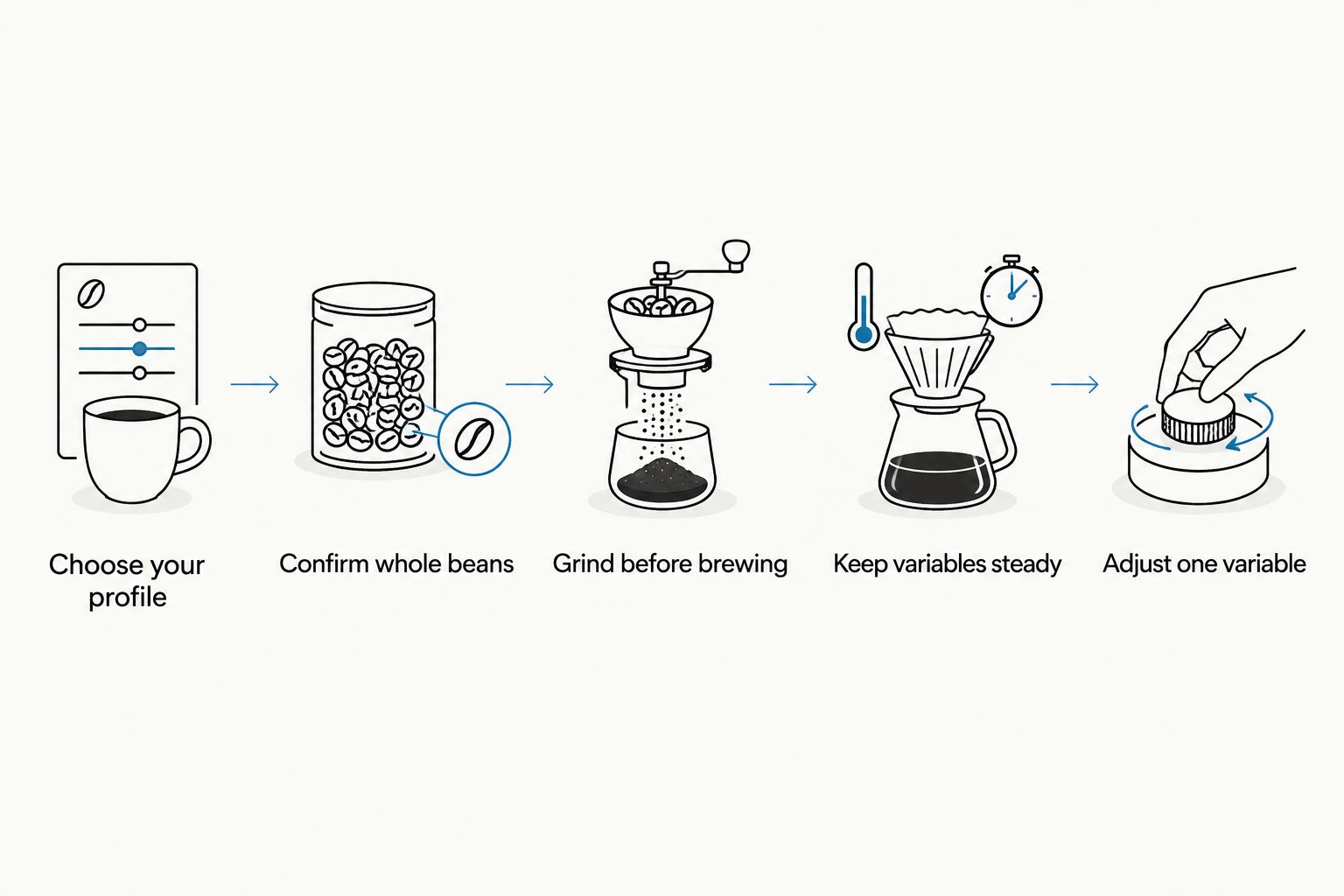
For your first comparison in 2026, use the same brewer, water, and recipe. A practical filter-coffee starting recipe is 15 grams of coffee with 250 milliliters of water. Treat that as a starting point, not a product-specific performance claim.
- Choose your profile: Pick the coffee whose listed flavors match your preference.
- Confirm whole beans: Check the selected format before ordering.
- Grind before brewing: Match your grind to the brewer you use.
- Keep variables steady: Use the same coffee dose and water amount for comparisons.
- Adjust one variable: Change grind or ratio separately, then taste again.
This sequence makes your next decision clearer: keep the coffee and adjust the brew, or choose a different flavor profile.
How the coffees were ranked
This 2026 ranking uses the published descriptions from God's Country Coffee Co., with flavor fit, stated roast, body, acidity, caffeine category, and format confirmation as the criteria. Peru takes the default slot because its description combines medium roast, sweetness, and citrus; each remaining coffee serves a distinct preference.
The order does not represent laboratory testing, customer review scores, or a verified freshness comparison. Missing roast, body, or processing details remain missing rather than becoming assumed advantages.
Which whole bean coffee should you choose?
Choose Peru if you are undecided. For whole bean coffee shoppers at God's Country Coffee Co., Peru is the default profile pick for medium-roast preferences built around caramel and citrus.
Choose Sumatra for syrupy body, Kenya for bright citrus, French Roast for a stated dark roast, Peru Decaf for reduced caffeine, or Tanzania for floral fruit notes. Your 2026 buying decision should follow that preference split, not the idea that one origin wins every brew method.
FAQ
What's the best whole bean coffee if I don't know what I like?
Peru is the default profile pick in this guide because its description combines medium roast, salted caramel, silky sweetness, and citrus. Confirm the whole-bean format, then use a consistent recipe to judge whether that flavor direction suits you.
Is whole bean coffee better than ground coffee?
Whole bean coffee gives you control over grind size and lets you grind immediately before brewing. Ground coffee removes the grinding step, so the better format depends on your equipment and routine.
Is Sumatra better than Kenya?
Sumatra is the better profile match for syrupy body and earthy, dark-chocolate notes; Kenya is the better match for bright citrus. The published descriptions address different preferences rather than establishing a universal winner.
What's the best option here for dark-roast drinkers?
French Roast is the dark-roast pick because its description explicitly identifies a dark roast. The description does not provide detailed tasting notes, so do not assume a particular flavor beyond the stated information.
Does Peru Decaf have no caffeine?
Peru Decaf is decaffeinated coffee, not a guarantee of zero caffeine. If you need to avoid caffeine entirely, confirm whether decaf fits that requirement before choosing it.
Do tasting notes mean fruit or chocolate was added?
Tasting notes describe perceived flavors and do not, by themselves, establish added ingredients. Check the ingredient and product information if you need to distinguish naturally perceived notes from flavored coffee.
What should I check before ordering whole bean coffee in 2026?
Check the selected coffee format, roast information, tasting description, and any caffeine requirements. Do not assume that a product name alone confirms whole beans or a particular roast level.
One last thing
A chocolate tasting note is not a roast level. Sumatra lists dark chocolate but does not state a roast level in the supplied description; French Roast explicitly states dark roast. Keep those two pieces of information separate when choosing your next bag.