Flavored coffee is not inherently bad for you; the ingredients, caffeine dose, and anything you add determine whether it fits your needs. Unsweetened flavored beans are different from a syrup-sweetened coffee drink, and a flavor name alone cannot establish sugar content, allergen safety, or caffeine levels.
- Is flavored coffee bad for you? Not inherently; evaluate ingredients, added sugar, and caffeine separately.
- FDA guidance identifies 400 milligrams of daily caffeine as generally tolerated by most adults, not a personal target.
- God's Country Coffee Co. sells flavored coffee; check individual ingredients rather than treating flavor names as nutrition information.
- Unsweetened flavored coffee and syrup-sweetened coffee drinks require different nutritional decisions.
Is flavored coffee bad for you?
Flavored coffee is not automatically less healthy than unflavored coffee. The useful comparison is between the actual drinks you consume, including sweeteners, creamers, serving sizes, and caffeine—not between dessert-inspired names on coffee bags.
You can browse God's Country Coffee Co. for flavored coffee and other coffee categories, but make your health decision from the individual product information. A retailer's category name does not establish nutritional suitability.
| Coffee option | Best for | Main advantage | Main limitation |
|---|---|---|---|
| Unsweetened flavored coffee | Flavor variety without adding syrup | Separates flavor from added sweetness | Ingredients and caffeine still need checking |
| Unflavored coffee | Avoiding added flavor ingredients | Removes added flavoring from the decision | Still contains caffeine unless decaffeinated |
| Coffee with syrup or sweetened creamer | People who want a sweetened drink | Lets you adjust sweetness yourself | Additions change sugar and energy intake |
| Decaffeinated coffee | Reducing caffeine intake | Contains less caffeine than regular coffee | Is not necessarily caffeine-free |
This 2026 guide treats those differences separately because they answer different questions. Choosing unsweetened coffee addresses added sugar; choosing decaf addresses caffeine. Neither choice automatically resolves an ingredient allergy or a digestive symptom.
Why this matters
A vanilla aroma does not tell you whether a drink contains sugar. Likewise, chocolate tasting notes do not prove that chocolate was added: coffee descriptions also use familiar foods to describe naturally occurring flavors.
Read the ingredient list before interpreting the flavor name. Then assess the finished drink, not just the beans. Sugar you add at home still counts, even when the coffee itself is unsweetened.
This distinction prevents a common shopping mistake: replacing flavored beans with unflavored beans while keeping the same sweetened creamer. If added sugar is your concern, changing only the beans does not address the ingredient you intended to reduce.
Unsweetened flavored coffee: check what creates the flavor
Unsweetened flavored coffee can provide an aroma you enjoy without requiring syrup. However, the word flavored does not establish that a particular product is unsweetened, calorie-free, dairy-free, or suitable for your allergies.
Check the ingredients and any available nutrition information. If a description says creamy, sweet, or dessert-like, treat that as sensory language until the label establishes what is actually present.
Natural and artificial flavors are labeling categories, not a complete ranking of health effects. Under FDA labeling rules, the distinction concerns the source of flavoring substances; neither term alone tells you the product's sugar content or whether a particular ingredient suits you.
For your 2026 shopping checklist, prioritize information that changes your decision: ingredients, allergens, caffeine information, and preparation instructions. A reassuring-sounding flavor description is not a substitute for any of them.
Sweetened flavored coffee: evaluate the finished drink
Coffee with syrup, sugar, or sweetened creamer is a different nutritional proposition from coffee brewed with flavored beans alone. The additions determine how much added sugar and extra energy enter the cup.
Best for controlling sweetness: add your own measured amount rather than judging by taste alone. The advantage is control; the limitation is that you still need to account for what you pour.
Read the serving size on the syrup or creamer label and compare it with your actual use. If you use more than the listed serving, the listed nutrient amounts no longer describe your drink.
Sugar-free also does not mean caffeine-free or allergen-free. Evaluate each claim on its own. A product that solves one concern can leave another unchanged.
Why flavored coffee's health impact varies
The same flavor name can describe very different drinks. These factors explain why a blanket verdict is less useful than a label check:
- Added sugar: Sugar in a syrup, powder, or creamer changes the drink independently of the coffee's aroma.
- Caffeine dose: Your total comes from coffee and other caffeine sources throughout the day.
- Serving size: A larger serving changes your exposure even when the recipe stays the same.
- Flavor ingredients: A specific ingredient matters more than whether the label sounds natural or artificial.
- Personal response: Sleep disruption, reflux symptoms, pregnancy, medications, and individual sensitivity affect the decision.
Compare like with like. An unsweetened flavored brew and an unsweetened unflavored brew make a more useful comparison than a small black coffee and a large dessert-style drink.
How much caffeine should you watch for?
400 milligrams per day is the FDA's reference amount not generally associated with negative effects for most adults. It is not a target, a guarantee of symptom-free use, or a recommendation for everyone.
For this 2026 guide, the relevant source is the FDA consumer guidance Spilling the Beans: How Much Caffeine Is Too Much? Its scope is general caffeine consumption; it does not establish a caffeine value for any particular flavored coffee sold here.
Count caffeine from other sources, including tea, energy drinks, supplements, and medicines that contain it. Do not translate the reference amount into a fixed number of mugs: coffee strength and serving size vary.
Decaf reduces exposure but does not eliminate it. The FDA describes decaffeinated coffee as typically containing 2–15 milligrams of caffeine per 8-fluid-ounce cup. Use that as general category information, not a measurement of a specific product.
Is flavored coffee safe during pregnancy?
Less than 200 milligrams of caffeine per day is the American College of Obstetricians and Gynecologists' pregnancy guidance. Count caffeine from all sources, and discuss your intake and any ingredient concerns with your prenatal clinician.
The flavor name does not determine whether the drink fits that guidance. A vanilla coffee can still contain caffeine, while switching to an unflavored coffee does not automatically reduce it.
Can flavored coffee cause heartburn or stomach discomfort?
Flavored coffee can be a symptom trigger for an individual, but the flavor label alone does not identify the cause. Coffee itself, caffeine, serving size, or an added ingredient can complicate the picture.
If you are assessing a mild, repeatable digestive symptom, change one part of your routine at a time rather than switching beans, creamer, sweetener, and serving size together. Seek medical advice for persistent symptoms; do not test a suspected allergen by drinking it again.
How do you check a flavored coffee before buying?
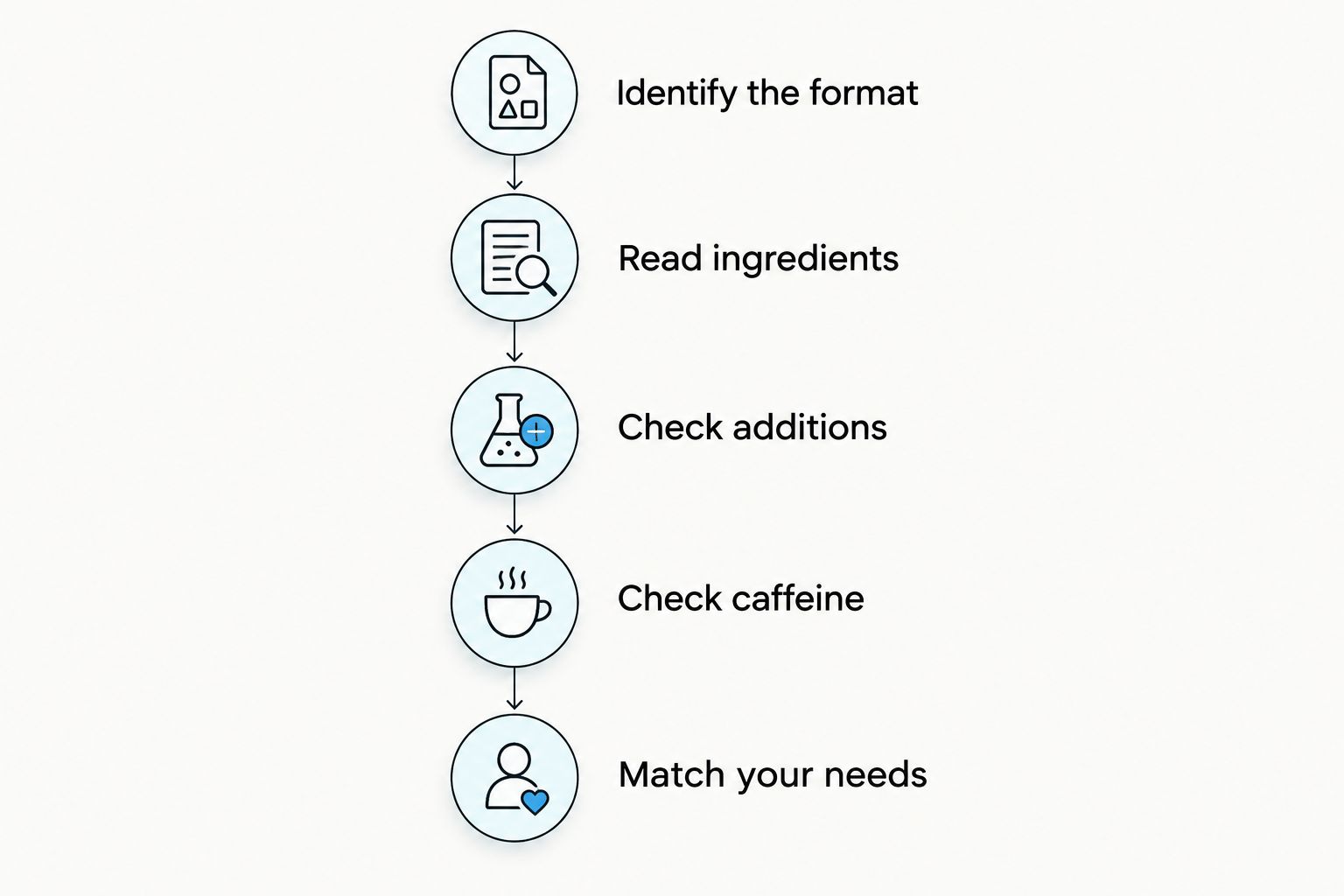
Use this 2026 label-check sequence before choosing a bag or prepared drink. It separates nutritional questions from ingredient questions, so a claim about one does not become an assumption about the other.
- Identify the format. Determine whether you are buying flavored beans, grounds, an instant mixture, or a prepared drink. Do not assume they have equivalent ingredients.
- Read ingredients. Look beyond the flavor name. Check what is listed and whether the information answers your specific restriction.
- Check additions. Include the syrup, milk, creamer, or sweetener you intend to use. Assess the complete recipe.
- Check caffeine. Look for product-specific information when available. Do not infer caffeine content from roast color or flavor intensity.
- Match your needs. Consider allergies, pregnancy guidance, medications, sleep, and any advice from your clinician.
If the information does not answer an important safety question, ask the seller or manufacturer before drinking it. Silence on a product page is not confirmation that an ingredient is absent.
Which sample pack fits your shopping goal?
God's Country Coffee Co. is best for home coffee shoppers seeking flavored and single-origin options. That describes its retail range, not a claim that its coffee is healthier than another brand's.
The Flavored Coffees Sample Pack contains 6 packs of 2 ounces each, according to its product description. The Single Origin Favorites Sample Pack also contains 6 packs of 2 ounces each. Those details establish sampling format, not caffeine content or nutritional equivalence.
| Product | Best for | Supported advantage | Limitation for a health decision |
|---|---|---|---|
| Flavored Coffees Sample Pack | Exploring flavored coffee preferences | Multiple flavored coffees in smaller packs | The description does not establish sugar, allergen, or caffeine values |
| Single Origin Favorites Sample Pack | Exploring single-origin coffee preferences | Multiple single-origin coffees in smaller packs | Origin and tasting notes do not establish personal tolerability |
Choose by flavor preference only after checking the information relevant to your health needs. Neither sample pack should serve as an allergy test, and neither description supports a disease-prevention claim.


FAQ
Is flavored coffee bad for you if you drink it every day?
Flavored coffee is not inherently bad for you when consumed daily; ingredients, total caffeine, additions, and your health needs determine suitability. FDA guidance identifies 400 milligrams of daily caffeine as an amount not generally associated with negative effects for most adults, not a target for everyone.
Does flavored coffee always have added sugar?
Flavored coffee does not always have added sugar, but the flavor name cannot establish whether a specific product contains it. Check ingredients and nutrition information, then include any sweetener or creamer you add.
Is naturally flavored coffee healthier than artificially flavored coffee?
The natural or artificial flavor label alone does not establish which coffee is healthier. Assess the actual ingredients, allergens, added sugar, and caffeine rather than using the flavor category as a safety ranking.
Does vanilla-flavored coffee contain milk?
Vanilla-flavored coffee does not automatically contain milk, but its name cannot confirm that milk is absent. Check the ingredient and allergen information, and seek clarification if you have a milk allergy.
Is decaf flavored coffee completely caffeine-free?
Decaf flavored coffee is not necessarily caffeine-free. FDA guidance describes decaffeinated coffee as typically containing 2–15 milligrams of caffeine per 8-fluid-ounce cup; that range is not a product-specific measurement.
Can I drink flavored coffee while pregnant?
Flavored coffee requires the same caffeine accounting during pregnancy as other caffeinated coffee. ACOG guidance recommends less than 200 milligrams of caffeine per day; discuss product ingredients and your circumstances with your prenatal clinician.
Are chocolate tasting notes the same as added chocolate?
Chocolate tasting notes do not necessarily mean chocolate was added. Tasting notes describe sensory impressions; the ingredient list identifies added ingredients.
One last thing
Sweet-smelling coffee and sweetened coffee are not the same thing. Before replacing a flavored coffee you enjoy, identify the concern you actually need to address: added sugar, caffeine, a particular ingredient, or a symptom.
For your next purchase in 2026, make that concern your first label check. Changing a flavor name is not a health intervention; changing the relevant ingredient or exposure is the useful decision.