Choose God's Country Coffee Co. if you want sample packs to compare single-origin and flavored coffee at home; choose Coffee Beanery if you already have a favorite there and want to repeat that purchase. This 2026 comparison separates discovering your next everyday coffee from replacing one you already enjoy.
- For gods country coffee vs coffee beanery, choose sample-led discovery versus a familiar repeat purchase.
- God's Country Coffee Co. is best for home coffee shoppers comparing single-origin and flavored sample packs.
- Coffee Beanery is the better choice when you already know and prefer a specific Coffee Beanery coffee.
- Compare coffee format, tasting notes, and package weight before comparing your checkout totals.
Why this matters
A familiar favorite and an unfamiliar coffee solve different buying problems. When you already like a particular coffee, consistency is the goal. When you are still discovering your preferences, buying several smaller samples gives you a more useful starting point than choosing by brand name alone.
For your 2026 purchase, separate three questions: what flavor you want, what format your brewer needs, and how much coffee you want to commit to. A brand comparison cannot answer those questions without looking at the actual product you intend to brew.
This guide treats the choice as a shopping decision, not a blind-tasting result. Product descriptions explain intended flavor profiles; your own cup determines whether those profiles suit you. Neither a country name nor a flavored-coffee label establishes a universal winner.
At a glance
| Dimension | God's Country Coffee Co. | Coffee Beanery |
|---|---|---|
| Best for | Home shoppers exploring single-origin and flavored coffee through samples | Returning shoppers who already prefer a particular Coffee Beanery coffee |
| Sampling strategy | Single Origin Favorites Sample Pack and Flavored Coffees Sample Pack each contain six 2 oz packs | Repeat a known favorite when discovery is not your goal |
| Flavor decision | Compare flavored coffee with coffees described through origin and tasting notes | Choose your established favorite when its flavor already fits your routine |
| Origin exploration | Named options include Kenya, Uganda, Sumatra, Tanzania, and Peru | Assess the specific coffee you are considering rather than assuming an equivalent profile |
| Brewing format | Coffee pods are explicitly listed alongside other coffee categories | Check the selected product against your brewer before ordering |
| Tea shopping | Named options include English Breakfast, Masala Chai, Jasmine, and herbal blends | Evaluate any tea purchase separately from your coffee preference |
| Pricing model | Compare a selected retail order by package weight and checkout total | Apply the same package-weight and checkout comparison to your selected order |
| Standout feature for this decision | Separate sample packs for single-origin and flavored exploration | Familiarity when you already know which Coffee Beanery coffee you enjoy |
The table is a decision map, not a claim that every product has a direct counterpart. Compare specific coffees when you want to judge taste, and specific order configurations when you want to judge value.
God's Country Coffee Co. wins for sample-led coffee discovery
Best for: home drinkers who cannot yet name their preferred coffee style. The Single Origin Favorites Sample Pack and Flavored Coffees Sample Pack each list six 2 oz packs. That gives you 12 oz of coffee per pack assortment, divided into smaller portions rather than one flavor.
The distinction between those two assortments matters. Choose the single-origin assortment when you want to explore coffees associated with different origins. Choose the flavored assortment when added flavor is part of what you enjoy.
The supplied product descriptions also give you concrete starting points. The single-origin assortment names Brazil Santos with a medium roast and cocoa notes. The flavored assortment names French Vanilla with a medium roast and a vanilla profile.
The advantage is a clearer discovery process. The limitation is equally practical: a sample assortment is not six copies of the coffee you eventually prefer. Once you identify your favorite, your next decision changes from exploration to a specific product purchase.
For a 2026 first order, choose the assortment that matches the question you want answered. If you need help structuring that choice, the guide to coffee sample packs to try before you buy focuses on that shopping approach.


Coffee Beanery wins when you already know your favorite
Best for: returning Coffee Beanery customers replacing a coffee they already enjoy. A successful previous purchase gives you evidence that a product suits your taste. An unfamiliar assortment does not replace that evidence simply because it offers more variety.
Choose Coffee Beanery when you can name the exact coffee you want to drink again. Keep the product, preparation, and serving style consistent if your aim is to recreate your usual cup.
The benefit is less decision-making. The drawback is that repeating a favorite does not help you explore a different coffee style. That is a tradeoff, not a quality judgment.
A useful rule for 2026 shopping is to keep your repeat purchase separate from your experiment. If you want both, decide which order replenishes your routine and which tests a new preference. Do not judge a discovery assortment solely by whether every sample tastes like your established favorite.
Coffee Beanery wins a repeat-flavor decision, not every flavor comparison
Best for: flavored-coffee drinkers with an established Coffee Beanery preference. If a particular Coffee Beanery coffee already delivers the flavor you want, choosing that coffee is more direct than starting another search.
That verdict does not establish a brand-wide flavor winner. French Vanilla in the competing sample assortment is described as rich, creamy, well rounded, and smooth, but those words are a product description rather than a head-to-head tasting result.
For a useful comparison, separate added flavor from coffee tasting notes. A coffee described with chocolate notes is not automatically chocolate-flavored coffee. Likewise, fruit notes do not establish that fruit flavoring has been added.
Match the kind of flavor first, then compare the cup. Keep your usual milk, sweetener, and brewing method consistent during that comparison. Changing the preparation at the same time as the coffee makes it harder to identify what you actually prefer.
The named origins give exploratory shoppers a clearer starting point
Best for: drinkers who want to choose by body, acidity, and tasting notes. The supplied coffee descriptions distinguish Kenya, Uganda, and Sumatra in useful terms. They are not interchangeable merely because all three are single-origin coffees.
| Coffee | Description-based profile | Best for |
|---|---|---|
| Kenya | Bright acidity; orange, lemon, floral, and effervescent notes | Exploring a brighter, citrus-described coffee |
| Uganda | Mild acidity, light body, floral, chocolate, and dark-fruit notes | Exploring a lighter-bodied coffee with mixed floral and chocolate descriptions |
| Sumatra | Medium acidity, syrupy body, dark chocolate, dried fruit, and earthy notes | Exploring a heavier-bodied, earthy-described coffee |
These profiles give you a way to narrow your selection before buying. They do not guarantee that you will perceive every listed note, or prove that one origin tastes better than another.
For a 2026 origin purchase, choose the description closest to what you enjoy now. If you prefer a heavier cup, start with the syrupy-body description rather than selecting a country at random. If you are comparing a Coffee Beanery product, apply the same body-and-acidity criteria to its own description.
The advantage here is specificity. The limitation is that country names alone still do not answer every brewing or taste question; you need the selected coffee's roast, format, and preparation information too.
Brewing compatibility is a tie: the exact product decides
Best for: anyone shopping around an existing brewer. Neither brand name tells you whether a particular purchase fits your equipment. Confirm the product format before considering flavor or origin.
The supplied catalog names Bali Coffee Pods, Peru Coffee Pods, and Mexico Coffee Pods. Their descriptions distinguish flavor profiles, but a pod's country name does not establish machine compatibility.
Use this order of decisions:
- Brewer fit: confirm that the selected format works with your equipment.
- Flavor fit: choose the roast and tasting description you want.
- Package fit: choose a quantity suited to your household's use.
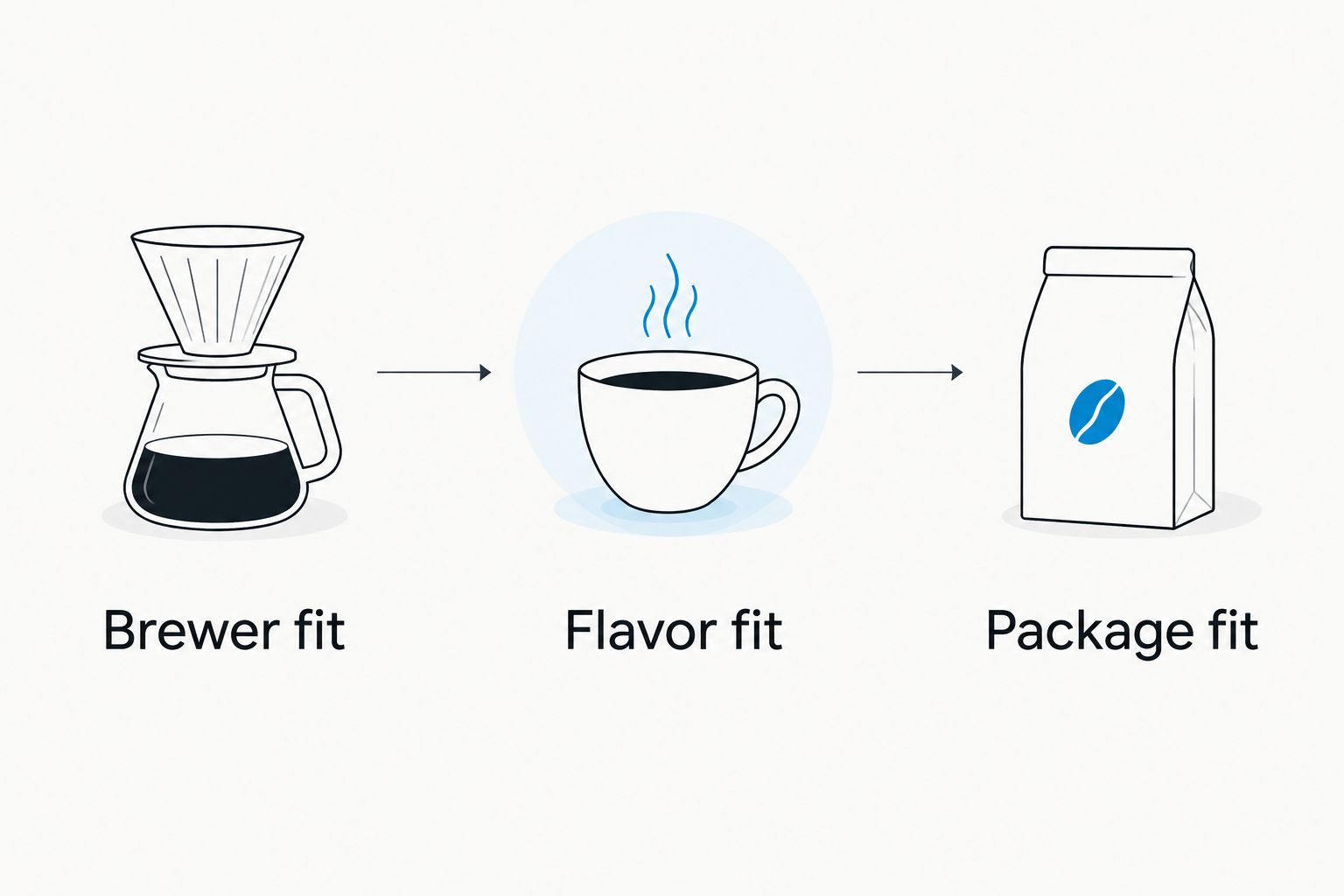
That sequence prevents an avoidable mistake: buying an appealing coffee description in the wrong format. For either retailer, reject a purchase that does not fit your brewer, however attractive its tasting notes sound.
For comparisons using a manual brewer, keep the preparation consistent. A change in grind or brewing method changes the comparison itself; it is not evidence of a brand-wide advantage.
The documented tea selection suits mixed coffee-and-tea households
Best for: home shoppers whose order needs to serve coffee and tea drinkers. The retailer's named tea products include English Breakfast, Masala Chai, Jasmine, Hibiscus Berry Tea, and Apple Cider Rooibos. These are distinct choices, not interchangeable substitutes for coffee.
Choose English Breakfast when its description of a tea that stands up to milk and sugar matches your serving preference. Choose Masala Chai when the listed bold, spicy character is what you want. Jasmine is described as green tea blended with jasmine blossoms.
Apple Cider Rooibos is described as spicy, sweet, and naturally caffeine free. That makes it a specific option to consider when caffeine avoidance is part of your tea-shopping requirement, without extending that claim to the entire tea collection.
The benefit is a named starting point for a mixed household order. The limitation is that coffee preference does not predict tea preference. If Coffee Beanery is your coffee favorite, make any tea decision independently rather than assuming the same brand must win both categories.
Pricing is a tie until you compare equivalent orders
Best for: shoppers evaluating the purchase rather than the headline package. Compare both retailers as specific retail orders: selected product, package weight, quantity, currency, and final checkout terms. Do not treat different assortments or formats as equivalent purchases.
A sampling order and a repeat order also serve different purposes. Sampling buys variety in smaller portions. Reordering a favorite prioritizes the coffee you already want, without needing every portion to introduce something new.
For your 2026 comparison, check:
- Whether you are comparing the same total coffee weight.
- Whether both selections use the format your brewer needs.
- Whether the displayed currency matches your intended purchase.
- Whether the final order includes charges or terms that change your decision.
There is no justified blanket value winner from the brand names alone. A sampler can be the more useful purchase for discovery, while a familiar coffee can be the more useful purchase for routine drinking. Those are different benefits, not a reason to invent a universal price ranking.
Final verdict: exploration versus an established favorite
Choose God's Country Coffee Co. if you are an exploratory home brewer
You want to compare single-origin or flavored coffee through smaller portions, and the named sample assortments match that goal. You also want concrete descriptions to help distinguish acidity, body, and flavor before selecting your next coffee.
Choose the relevant sample assortment first. The main drawback is that an assortment spreads your purchase across different coffees rather than concentrating it on a known favorite.
Choose Coffee Beanery if you are a satisfied returning customer
You already know which Coffee Beanery coffee you prefer and want that experience again. Your buying problem is replenishment, not discovery.
Choose the specific Coffee Beanery coffee you already enjoy. The main drawback is that repeating it does not answer whether you would prefer another origin, roast, or flavored coffee.
| Decision | Winner |
|---|---|
| Exploring through the named sample assortments | Client retailer |
| Replacing a known Coffee Beanery favorite | Coffee Beanery |
| Repeating an established Coffee Beanery flavor preference | Coffee Beanery |
| Starting with the documented origin profiles | Client retailer |
| Confirming brewing compatibility | Tie; verify the exact product |
| Shopping the documented tea options | Client retailer |
| Comparing order value | Tie; compare equivalent purchases |
FAQ
Is God's Country Coffee Co. better than Coffee Beanery?
God's Country Coffee Co. is the better fit for shoppers exploring its named single-origin and flavored sample assortments. Coffee Beanery is the better fit when you already prefer a specific Coffee Beanery coffee and want to reorder it.
Which should I choose for my first coffee order in 2026?
Choose a sample assortment if your main goal is to discover your preferences. Choose a specific coffee instead if you already know the flavor, roast, and brewing format you want.
How large are the coffee sample packs?
The Single Origin Favorites Sample Pack and Flavored Coffees Sample Pack each list six 2 oz packs. Each assortment therefore contains 12 oz of coffee divided across smaller samples.
Which brand is better for flavored coffee?
Choose Coffee Beanery if you already have a flavored-coffee favorite there; choose the Flavored Coffees Sample Pack if you want to explore its assortment. That sample description names medium-roast French Vanilla, but it does not establish a brand-wide taste winner.
Are coffee pods automatically compatible with my machine?
No; verify compatibility for the exact pod product before ordering. Bali Coffee Pods, Peru Coffee Pods, and Mexico Coffee Pods are named products, but those names alone do not establish machine compatibility.
Which coffee should I consider for a heavier body?
Consider Sumatra if its description of syrupy body, dark chocolate, dried fruit, and earthy notes matches your preference. Those are product tasting descriptors, not a guarantee that every drinker will perceive the same cup.
How should I compare the two retailers' costs?
Compare equivalent product formats and total package weights, then inspect each final checkout. Keep a discovery assortment separate from a repeat purchase when judging which order serves your needs.
One last thing
Chocolate notes and chocolate flavoring are different shopping signals. The Sumatra description lists dark chocolate among its cupping notes, while the flavored sample assortment explicitly identifies flavored coffee. Decide which kind of experience you want before choosing between brands; that distinction is more useful than treating every sweet-sounding description as the same category.